

Risk Management · 2025
In this section4 topics
Risk Management Policy & Plan
Sub Introduction
Enterprise Risk Management
The Company recognizes the importance of risk management as a fundamental foundation of effective organizational management and as a key mechanism in supporting the achievement of business objectives, including revenue generation, profitability, and the protection of the interests of all stakeholder groups.
The Company has therefore established an Enterprise Risk Management (ERM) system and promotes risk management as part of its organizational culture. The Company has also developed and maintained a risk management policy to ensure that its operations are conducted prudently, transparently, and with the ability to respond appropriately to potential changes and uncertainties.
Principles and Guidelines of the Risk Management Plan
The Company’s risk management policy requires that its strategic plans, operational plans, and business activities be carried out with an appropriate balance between risk and return, in order to ensure that the organization can achieve its objectives, business goals, and stakeholder expectations within an acceptable level of risk.
In this regard, the Company has established a systematic, continuous, and timely risk management process, which includes the following key elements:
Risk Identification and Assessment
Determination of Risk Appetite
Risk Mitigation Measures
Monitoring and Reporting of Risk Management Results
Regular Evaluation of the Effectiveness of the Risk Management System
These practices help strengthen the stability of the Company’s business operations and support the organization’s ability to grow in a sustainable and responsible manner for all stakeholders.
Policy & Plan Description
Risk Management Plan and Framework
Ratchaphruek Hospital Public Company Limited has established a clear risk governance structure covering the Board of Directors, executives, and employees to ensure that risk management is integrated into strategic planning and daily operations.
1. Risk Governance Structure
1) Board of Directors
Review and approve the Company’s risk management policy
Oversee and support implementation of the policy
Determine the Company’s risk direction and Risk Appetite
Perform duties as stipulated in the Charter of the Risk Management Committee
2) Risk Management Committee
Review and propose risk management policies and frameworks to the Board of Directors
Provide opinions on strategies and risk oversight across all business dimensions
Define acceptable risk levels and Key Risk Indicators (KRIs)
Consider significant risks and propose control measures and mitigation plans
Support the development of effective Risk Governance and continuously enhance the risk management system throughout the organization
3) Hospital-Level Risk Management Working Committee
Communicate and implement risk management policies and frameworks
Compile, analyze, and prepare risk management reports
Report periodically to the Risk Management Committee
4) Department Managers (Risk Owners)
Act as “Risk Owners” within their respective departments
Implement control measures and continuously monitor risks
Report incidents and risk events through designated systems
5) All Employees
Comply with approved risk management policies
Report observed risks or incidents
Contribute to fostering a strong risk culture within the organization
The Company has established a Risk Culture learning channel. Employees may study the organization’s Risk Culture through an E-Book via:
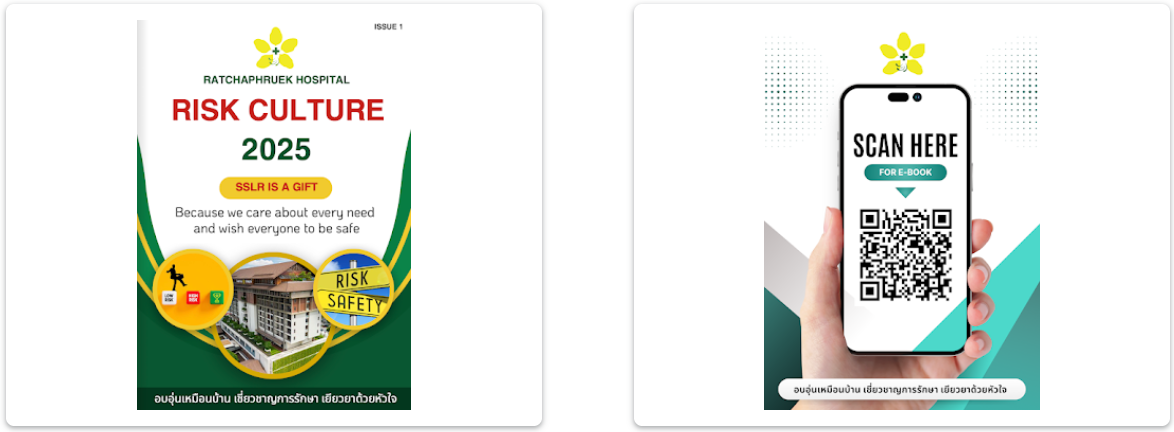
Option 1: Click the link https://heyzine.com/flip-book/af8210f74d.html or scan the QR Code provided.
Risk Management Process
The Company implements a structured risk management process as follows:
1. Risk Identification
Identify both proactive and reactive risks under the “Eh, That’s a Risk” initiative
Conduct at least once per year
Cover strategic, financial, operational, legal, information technology, and reputational risks
2. Risk Prioritization
Utilize a Risk Matrix assessment tool
Calculate the Risk Priority Number (RPN) using: Likelihood x Impact
Classify risks into High / Medium / Low levels
Determine appropriate control measures based on severity
3. Risk Reporting
Report incidents through the SSLR (Safety Security Learning Report) system
Relevant units must report incidents within prescribed timelines
Continuously analyze risk trends
4. Risk Management and Investigation
Risk management is categorized into two approaches:
Preventive Management
Establish preventive control measures
Conduct training and improve operational processes
Corrective Management
Perform Root Cause Analysis
Implement corrective and preventive actions
5. Management of Related Claims
Collect information on claims or damages that may affect the Company’s reputation
Analyze legal implications and associated risks
Negotiate and present matters to the Chief Executive Officer
Proceed with appropriate legal actions as necessary
6. Monitoring and Reporting
Monitor risk management performance at least quarterly
Report to the Risk Management Committee and the Board of Directors
Regularly review and improve the risk management plan
Alignment with International Frameworks
COSO Enterprise Risk Management (ERM) Framework
Good Corporate Governance Principles of the SEC and SET
Integration with ESG and Sustainability Risks
Risk Factors — Overview
Risk Factors — Introduction
The Company focuses on creating a risk management culture throughout the organization to create awareness and participation in risk management covering operations at the operational level, such as promoting employees and executives at all levels to see the importance of risk management through the organization’s core values, setting risk management performance as the organization’s and various departments’ KPIs, monitoring risks in the continuity of information systems, and risks in preparing employees’ competencies for international standards, as well as organizing training or disseminating knowledge about risks and risk management to senior executives and personnel throughout the organization. Organizing training or disseminating knowledge about risks and risk management is an important step that helps enhance understanding and skills in risk management in the organization, promoting risk culture, methods for creating a risk-focused culture in the organization, and creating an atmosphere that promotes positive outcomes of risk, communicating and disseminating knowledge about risks in the organization through the Risk Champion Team, and initiating new employees.
Risks to the Company's Business Operations
Risk Register
| Risk Name | Risk Characteristics | Consequences | Management Measures | Related Risk Factors |
|---|---|---|---|---|
| Risk from Increased Competition in the Hospital Business and Medical Staff Shortage | The hospital and medical service business is highly competitive, both from the public and private sectors, all of which are constantly working to improve the quality of care and services provided to patients. To maintain its values and remain the top hospital in Khon Kaen, the Company places great importance on both domestic and international healthcare standards to serve patients, whether they are from Khon Kaen or abroad. Furthermore, medical schools are elevating their services by opening hospitals that offer private-sector-level care to attract renowned doctors, which increases competition with private hospitals such as Srinakgarin Hospital, Faculty of Medicine, Khon Kaen University. As a result, competition for market share in this area is expected to intensify. | Medical services depend on qualified medical personnel across various specialties, and currently, the supply is limited. Additionally, the growing demand for skilled and experienced personnel due to the expansion of medical services presents a challenge, as these professionals require significant time to develop the necessary expertise. This can lead to future impacts from a shortage of medical staff in various areas. Due to the rapid growth of the healthcare industry, the number of medical professionals in the system is insufficient to meet market demand. Many private sectors are recruiting from the public sector, and there is internal competition within the private sector, indirectly raising business costs as higher compensation is needed to attract skilled personnel, especially medical specialists, who are key to the business’s success. | the Company has not faced any issues with medical staff shortages in the past, thanks to strong relationships between the management and major shareholders with local medical professionals, along with fair compensation and benefits, and a positive working environment. Additionally, the Company provides training programs and scholarships to qualified medical staff, aiming to enhance skills and promote continuous learning, which helps strengthen the staff's commitment to the organization and reduce the risk of a medical staff shortage. | 738 · Description: Reliance on employees in key positions · Info category: OPERATIONAL_RISK · 739 · Description: Shortage or reliance on skilled workers · Info category: OPERATIONAL_RISK · 1714 · Description: Competition risk · Info category: STRATEGIC_RISK |
| IT Risk and Cyber Security | In the current era of rapid technological changes, the hospital business sector must adapt accordingly. The use of technology in managing systems and integrating modern medical equipment with the hospital's internal information systems has become essential. | However, this also increases the risk of facing cyber threats, which are steadily growing in complexity, such as Distributed Denial of Service (DDoS) attacks that disable systems, or "Malware" programs that interfere with systems to execute money transfer commands through SMS or by attaching suspicious files to websites. These threats can affect patient data and the hospital's operations. | Therefore, the Company must oversee and manage information technology, including personnel, processes, and the application of technology, within a properly and sufficiently managed risk framework. This is done to address potential risks, with a focus on safeguarding patient data. The Company fosters a culture and collective behavior across the organization to raise awareness of potential risks, establishes appropriate information security policies, assigns roles and responsibilities, and continuously monitors risks. It also ensures the organization has sufficient skilled personnel and regularly strengthens knowledge and understanding of technology. The company has proactively managed risks in two ways: 1) Preventive Control, with regular penetration tests and regular updates of anti-virus programs, as well as providing knowledge to employees in all departments; 2) Detective Control, by structuring the network to create continuity in all situations. In addition, the hospital has implemented information system security in accordance with JCI to ensure that the information system meets international standards and has clear procedures. | 744 · Description: Information security and cyber-attack · Info category: OPERATIONAL_RISK · 1720 · Description: System disruption risk · Info category: OPERATIONAL_RISK |
| Risk from Changes in Regulations and Government Measures | Compliance risks from new laws and regulations Hospitals operate under a number of regulatory bodies, including the Ministry of Public Health, the Medical Council, other professional councils, and the Securities and Exchange Commission, and are therefore subject to a number of new regulations and laws that must be complied. Currently, the government plays an increasingly significant role in regulating and controlling the operations of private hospitals, such as setting prices for medicines, medical supplies, and treatment fees. The government also enforces policies that regulate prices and conditions for medicines, medical supplies, and treatment, which can impact the revenue of private hospitals. | Risk from Regulatory Criteria on the Sale of Medicines, Price Notification, and Price Setting Conditions Regulations regarding the sale of pharmaceutical products, medical supplies, and medical service fees, as set by the Central Committee on Product and Service Prices (CPPC), require private hospitals to report the prices of medicines and services before providing them, as well as to control the prices of medicines and hospital services. This has led to a potential slowdown in revenue and net profit growth for private hospitals. | In the past, the company has been able to communicate and comply with various rules completely, within an acceptable risk level. The risk management approach is as follows: 1) Always follow new rules and announcements from government agencies, analyze stakeholders of those involved in such rules, and systematically communicate the guidelines. 2) Provide knowledge to employees in all sectors. 3) Create a Work flow if there is an operation that is not in line with such rules, so that who should do what and how, in order to respond to such matters quickly. | 728 · Description: Volatility in the industry in which the company operates · Info category: STRATEGIC_RISK · 756 · Description: Change in laws and regulations · Info category: COMPLIANCE_RISK · 757 · Description: Laws and regulations is not favorable for doing business · Info category: COMPLIANCE_RISK · 730 · Description: Government policy · Info category: STRATEGIC_RISK |
| Risk of Lawsuits from Service Users and (3) Risk of Violation of Patient Rights | The medical service business carries the risk of being sued by patients or their relatives, which may arise if the service standards or treatment outcomes do not meet their expectations. | As the Company operates a hospital, it handles a significant amount of health service data and sensitive information. Therefore, it is essential to systematically and strictly maintain patient data, including information related to treatments, such as personal details, medications used, allergies, or side effects from treatments, as well as disease treatment data, while preventing the increasing risk of data theft. | Considering the risks in such areas, the Company has prepared plans, systems and measures to prevent and mitigate the impacts of such risks, including: (1) The Company acknowledges this risk factor and continuously works to improve service standards, both in terms of treatment procedures and the evaluation of medical outcomes. The Company has established methods for assessing customer satisfaction alongside managing the risks associated with customer complaints, aiming to resolve issues before they escalate into legal disputes. This approach helps minimize the impact of such risks. (2) In addition, The Company has established information security management policies, including creating operational manuals, guidelines, and preventive measures. It has also developed a personal data protection policy in compliance with the Personal Data Protection Act B.E. 2562. A Data Protection Officer (DPO) has been appointed to provide advice and monitor patient data processing to ensure compliance with the Company's policies. The Company defines access rights, usage, and storage of patient information within the hospital, disseminates knowledge, and provides training to employees and medical personnel to raise awareness of the importance of personal and patient data. (3) Set up different access levels to define the information confidential level. Effectively manage the data access to prevent confidential data access and data espionage, as well as set up the information access system in order to effectively review and monitor the data access. | 758 · Description: Violations of laws and regulations · Info category: COMPLIANCE_RISK · 1723 · Description: Legal risk · Info category: COMPLIANCE_RISK |
| Financial and Receivables for Medical Services Risk | • Risk from Inability to Comply with Loan Agreement Conditions The Company has entered into loan agreements with financial institutions, both for long-term and short-term credit facilities, to fund its operations. Some of these loan agreements include key conditions that the Company must comply with, such as maintaining financial ratios, including a debt-to-equity ratio of no more than 2.5 times and a Debt Service Coverage Ratio (DSCR) of no less than 1.25 times. | • Risk from Inability to Comply with Loan Agreement Conditions Additionally, the Company is required to maintain Dr. Teerawat Srinakarin’s shareholding ratio of at least 10% of the total shares throughout the loan period, unless prior approval is obtained from the financial institution. Other conditions include limitations on incurring additional debt and making payments to other creditors, which also require consent from the financial institution. If the Company fails to meet these conditions, it could lead to a breach of the loan agreement, potentially allowing the financial institution to demand immediate repayment, which could affect the Company’s liquidity and operations. • Risk from interest rate fluctuation Interest rate risk arises from changes in interest rates, which can negatively impact the Company and its subsidiaries both currently and in the future. The Company expects no significant impact from interest rate fluctuations on its performance. Exchange rate fluctuations affect the cost of importing medical supplies and medical equipment. • Risk from Receivables for Medical Services The Company provides medical services to general patients, aside from those covered by government health welfare schemes, and bills for medical fees after treatment in accordance with medical ethics. This exposes the Company to the risk that it may not be able to collect the full amount for medical services provided. | • Risk of failure to comply with the loan conditions of financial institutions Dr. Teerawat Srinakarin, who is both an executive and a major shareholder of the Company, having co-founded the Company since 1993 for more than 30 years, has acknowledged the conditions for maintaining the shareholding proportion and will proceed according to the conditions of the said financial institution. In addition, the Company has a good relationship with the said financial institution. The Company has a good payment history throughout the period of receiving the loan. Therefore, the Company's executives are confident that they will be able to comply with the important conditions of the financial institution very well. • Risk from interest rate fluctuation Manage exchange rate risk: Use hedging instruments such as forward contracts and options. As of December 31, 2025, the Company has no risk from interest rate fluctuation because the Company has no outstanding long-term loans from financial institutions. • Risk from Receivables for Medical Services According to the medical ethics, the company will provide medical treatment to patients before collecting medical fees. Therefore, the company is at risk of not being able to collect medical fees from service users after the treatment. The company has a risk prevention from accepting medical bill payments from all types of patients by informing service users of the expenses incurred every day or when the expenses reach 50,000 baht and allowing them to pay in installments. In the case of customers who use the right to treatment under a contract with the hospital, the right to claim medical fees will be checked. The company also provides credit to groups of customers with contracts, considering the financial status of the contracting parties to reduce the risk of overdue payments and collection. In addition, in terms of debt collection, the company has set a stricter debt collection policy and set indicators for debt collection staff to make debt collection more efficient. | 762 · Description: Change in financial and investment policies of financial institutions that affect business operations · Info category: FINANCIAL_RISK · 763 · Description: Default on payment or exchange of goods · Info category: FINANCIAL_RISK · 764 · Description: Fluctuation in exchange rates, interest rates, or the inflation rate · Info category: FINANCIAL_RISK |
| Clinical Risk | Patient Safety Risk Patient safety is the company's first priority and core strategy, which can be measured by the assessment from the JCI team, which focuses on quality and patient safety.Patient safety is a basic right that patients should receive from a medical facility that will not cause or have the opportunity for adverse events to occur from the service. | Patients receive unsafe services, both from communication and falls, which affect their lives, leading to the risk of disputes and lawsuits, as well as damage to the organization's reputation and image. | As a JCI-certified hospital with a policy that emphasizes patient-centric care, the company recognizes the importance of the hospital quality development process to enhance the quality dimension of safety under the International Patient Safety Goals (IPSG) to achieve the hospital's vision of being the most trusted. The risk management department has implemented the following clinical risk management: • Safety Culture Development In other words, the risk management department understands that success in risk management must come from decentralization and centralization. Having a centralized risk team alone may not be enough to manage risks in a timely manner. Therefore, in 2025, a Ward Risk Coordinator or Risk Champion will be appointed to proactively assess, manage, and monitor patient safety risks. There will also be regular training and knowledge sharing for Risk Champions. • Risk Champion Development The company has organized training in effective negotiation techniques, including collecting feedback from service recipients to continuously develop the service. Developing the risk reporting process (Incident Report) The risk management department, including the information system department, has developed an Incident Report system that can be entered immediately (real time) and has a mechanism to create incentives to use the system, especially filtering Near miss data to create a systematic early warning index. Preventive Plan The purpose is to reduce patient safety risks by walking around the patients every morning (Risk Around), communicating about safety and giving attention to safety. | 729 · Description: Behavior or needs of customers / consumers · Info category: STRATEGIC_RISK |
| Environmental risks and impacts | Environmental risks and impacts from 2016 to the present have not led to any complaints from the local community surrounding the Company. The Company places significant importance on the environmental impact of its services and medical treatments as a follower, (1) Natural disasters, floods affect infrastructure, medical equipment, medicines and patient services. Drought affects the amount of water used in operations and production costs, affecting infrastructure, medical equipment, medicines and patient services. (2) Stricter government policies on the environment, such as pollution control laws, laws and regulations on climate change, such as carbon pricing, affect operating costs, energy conservation standards. (3) Changing consumer behavior: Current consumer demands, patients demand more environmentally friendly products and services, and sustainable health services, affecting the organization's image. | • Higher operating costs • Higher regulatory compliance costs: installing pollution control systems, purchasing clean energy • Higher operating costs: higher energy prices, higher water costsPatient losses due to patients choosing hospitals with better environmental policies, less polluting • High environmental impactLimited access to capital: higher interest rates, stricter loan terms, funding for environmental projects | The company has established guidelines for managing environmental concerns within the hospital area, such as using dust and fume extraction systems, odor control, cleaning agents, and conducting sound and environmental condition tests to avoid disturbing the residents in the areas near the hospital. These measures are also aimed at reducing potential environmental impacts on employees. • Monitor changes in government policy by following new laws and regulations related to climate change and • Assess impacts and develop strategies to reduce carbon by reducing greenhouse gas emissions, • Increase energy efficiency, develop environmentally friendly products and services Reduce energy use, water use and waste production, invest in new technologies Green technology: Apply new technologies such as energy-saving technology, renewable energy technology to reduce costs • Increase efficiency and develop services, focusing on building relationships with stakeholders such as government, environmental organizations, communities | 750 · Description: Climate change and disasters · Info category: OPERATIONAL_RISK · 751 · Description: Impact on the environment · Info category: OPERATIONAL_RISK |
Risks to Securities Holders' Investment
Risk Register
| Risk Name | Risk Characteristics | Consequences | Management Measures | Related Risk Factors |
|---|---|---|---|---|
| Risks from Low Free Float of the Company’ Securities, which may result in Transaction Liquidity in the Stock Exchange of Thailand (SET) | Risks from Low Free Float of the Company’ Securities, which may result in Transaction Liquidity in the Stock Exchange of Thailand (SET) ("Free float") is relatively low, affecting the liquidity of trading on the Stock Exchange of Thailand. As of December 31, 2025, the Company has 4,278 retail shareholders, with a proportion of retail shareholders' shares (Free Float) accounting for 71.94%. | If the shareholding of major shareholders is very high, the free float will decrease, which may result in lower trading liquidity. As a result, shareholders may face the risk of being unable to sell the Company’s shares immediately at their desired price. Stocks with a high free float tend to be less volatile than those with a low free float, and they are less likely to experience price distortion or abnormal price movements, as it requires a larger amount of money to move the share price significantly. In contrast, stocks with a low free float tend to be more volatile. | The Company shall monitor and maintain the liquidity of Free float to be appropriate according to the criteria set by the Stock Exchange. | 2975 · Description: Risk from the stock having low free float, resulting in low trading liquidity · Info category: HOLDER_RISK |
| Risks from the Control of Major Shareholder | As of December 31, 2024, Dr. Teerawat Srinakarin is a major shareholder of the Company, holding approximately 12.15 percent of the paid-up capital. | As a major shareholder, Dr. Teerawat Srinakarin can control the resolutions of the shareholders' meeting in various matters, whether it is the appointment of directors or the request for resolutions on other matters that require a majority vote of the shareholders' meeting, as well as matters that the law or the company's regulations stipulate that a three-quarter vote of the shareholders' meeting is required. Therefore, other shareholders of the company may be at risk from being unable to collect votes to counterbalance matters proposed by major shareholders. | However, in order for the business to be transparent and in accordance with the principles of good corporate governance, the company has established a management structure comprising personnel with knowledge and capabilities and has clearly defined the scope of authority and duties, including appointing an audit committee comprising three independent directors who have no conflict of interest with the company to perform the duty of inspecting the company's operations and taking care of the interests of minority shareholders adequately, which creates a balance of power in management at an appropriate level and can be audited. | 769 · Other name: Risks from the Control of Major Shareholder · Description: Other · Info category: HOLDER_RISK |