

MD&A · 2025
In this section4 topics
Overview of Operations
Overview of Operations
Economic and Industrial Conditions1
Thailand’s economic outlook for 2026 remains fragile, with GDP for 2025 projected growth at only 1.8-2.0% before slowing to 1.5-1.7% in 2026, reflecting pressures from both external and domestic factors. With key risks from global economic uncertainty, limited recovery in domestic purchasing power, political stability concerns, and structural constraints within the Thai economy. Although growth continues to be supported mainly by the tourism and services sectors, the manufacturing sector and domestic consumption have not yet fully recovered, resulting in uneven economic expansion and increasing risks to Thailand’s long term growth potential.
The Northeastern economy in 20262 is expected to expand at a limit, with GDP projected to grow approximately 1.8% in 2025 before slowing down to 1.7% in 2026, reflecting a fragile recovery in domestic purchasing power. Household consumption remains constrained by high living costs and elevated debt burdens, while the manufacturing and trade sectors are likely to slow in line with subdued demand, in addition to government spending remaining below target due to policy uncertainty. Under these conditions, economic growth in the Northeastern continues to rely on recovery in specific industry, requiring businesses to adapt and enhance operational flexibility.
For the growth outlook3 the hospital industry in 2026 is expected to enter a phase of slower expansion, in line with Thailand’s economic conditions and subdued domestic consumption. Meanwhile, competition within the private hospital sector is expected to intensify, particularly in pricing strategies, promotional initiatives, service differentiation, and the integration of technologies and artificial intelligence to enhance services. These factors are likely to result in higher competitive costs and increase in capital investment requirements. Over the next 1-3 years, industry growth is projected to remain relatively constrained.
Under this context, the Company has adopted a strategy to enter the aesthetic hospital business, focusing on investing in a market with growth prospects aligned with hospital industry trends and evolving consumer behavior reflecting demand for healthcare and beauty services. At the same time, the Company places importance on investment risk management and maintaining the profitability of its core business during a period of limited industry growth.
Summary of the operating results
In 4Q25, the Company recorded total revenue of THB 300.02 million, decreasing by 5.88% compared to the previous quarter, due to 3Q25 being the high season resulting in a high revenue base. However, compared to the same period last year, total revenue increased by 8.50% from revenue from hospital that continued to expand. As a result, for the year 2025, the Company recorded total revenue of THB 1,187.74 million, increasing by 3.32% from the previous year, and net profit of THB 182.37 million, increasing by 5.70%, while earnings per share were THB 0.34, increasing by 6.25% from the previous year.
Operating Results & Financial Condition
Operating Results & Profitability
Revenue
In 2025, the Company recorded total revenue of THB 1,187.74 million, increasing by 3.32% from the previous year. The main reason was from a higher revenue from the hospital due to an increase in volumes of both outpatient (OPD) and inpatient (IPD), as well as higher revenue per visit, resulting in increased revenue from both outpatient (OPD) and inpatient (IPD). Meanwhile, other income was THB 25.74 million, increasing slightly from the previous year.
Cost of hospital operations
In 2025, the Company’s cost of hospital operations was THB 771.53 million, increasing by 2.67%. The main reason was due to higher drug and medical supply costs, which are variable costs in line with revenue growth. The ratio of hospital operating costs to hospital revenue decreased compared to the previous year, at 66.40% and 66.78%, respectively, resulting from an improved cost management efficiency.
Distribution costs and administrative expenses
In 2025, the Company recorded distribution costs and administrative expenses totaling THB 184.67 million, increasing by 1.90% compared to the previous year. The main reasons were higher personnel expenses and repair and maintenance costs. The ratio of distribution costs and administrative expenses to total revenue was 15.55%, close to the previous year of 15.76%, reflecting effective expense management.
Finance cost
Finance costs in 2025 amounted to THB 0.51 million, decreasing from THB 0.57 million the previous year.
Net profit
In 2025, the Company recorded a net profit of THB 182.37 million, increasing by 5.70% from the previous year. The main reasons were higher revenue from the hospital, increased patient volumes, and higher revenue per visit for both outpatient (OPD) and inpatient (IPD), additional with the hospital operating costs efficient management. As a result, the Company was able to maintain a lower cost-to-revenue ratio, reflecting its ability to deliver quality earnings growth.
Liquidity & Capital Adequacy
As of 1 January 2025, the Company had beginning cash and cash equivalents of THB 291.49 million. For 2025, the Company generated cash from operating activities of THB 300.78 million, with payments for corporate income tax of THB 48.82 million and payment for employee benefit obligations of THB 3.15 million, in result with Net cash provided by operating activities of THB 248.81 million. In respect of investing activities, the Company had Net cash used in investing activities of THB 30.45, from payments for the purchase of new medical equipment, despite receiving proceeds from mature fixed deposits. The Company had Net cash used in financing activities of THB 229.67 million, primarily for dividend payments and the share repurchase program. As a result, the Company had ending net cash and cash equivalents as of 31 December 2025 of THB 280.18 million, decreasing by THB 11.31 million from the beginning of the year.
Debt Obligations & Off-Balance-Sheet Management
As at 31 December 2025, the Group had commitments and contingent liabilities as follows:
Company
1 Payment under consulting agreement in the amount of Baht 0.51 million.
2 Payment under service agreement in the amount of Baht 4.78 million and USD 0.002 million.
3 Payment under purchase of assets agreement in the amount of Baht 5.04 million.
4 Payment under software development agreement in the amount of Baht 0.11 million.
5 Letters of guarantee issued by banks in the amount of Baht 2.80 million.
Subsidiary
6 Payment under consulting agreement in the amount of Baht 2.77 million.
7 Payment under service agreement in the amount of USD 0.01 million.
8 Payment under structure design and construction agreement of building in the amount of Baht 261.73 million.
Material & Related-Party Transactions
The significant transactions with related parties for the years ended 31 December 2025 was as follows:
1. Revenues from hospital operations in the amount of Baht 0.38 million.
2. Cost of hospital operations in the amount of Baht 15.36 million.
3. Other income in the amount of Baht 0.49 million.
4. in the amount of Baht in the amount of Baht 0.13 million.
5. Service fees in the amount of Baht 0.80 million.
The balances with related parties as at 31 December 2025 was as follows:
6. Trade and other receivables in the amount of Baht 0.05 million.
7. Trade and other payables in the amount of Baht 0.64 million.
Debt Securities with Financial Ratio Requirements
Debt Securities with Financial Ratio Requirements Issued?
No
Factors That May Affect Financial Condition
Factors or Incidents That May Materially Affect Financial Condition
Business Challenges and Opportunities
Although the situation of emerging infectious diseases and other contagious diseases in Thailand has gradually improved, such events have accelerated global changes in economic conditions and business environments. As a result, organizations, including the Company, may face various uncertainties and challenges arising from both internal and external factors.
The Company therefore places importance on continuously monitoring, analyzing, and managing potential risks in order to adapt effectively and maintain sustainable business operations. Key factors are summarized as follows:
Internal Factors
1) Investment in a New Surgery Hospital
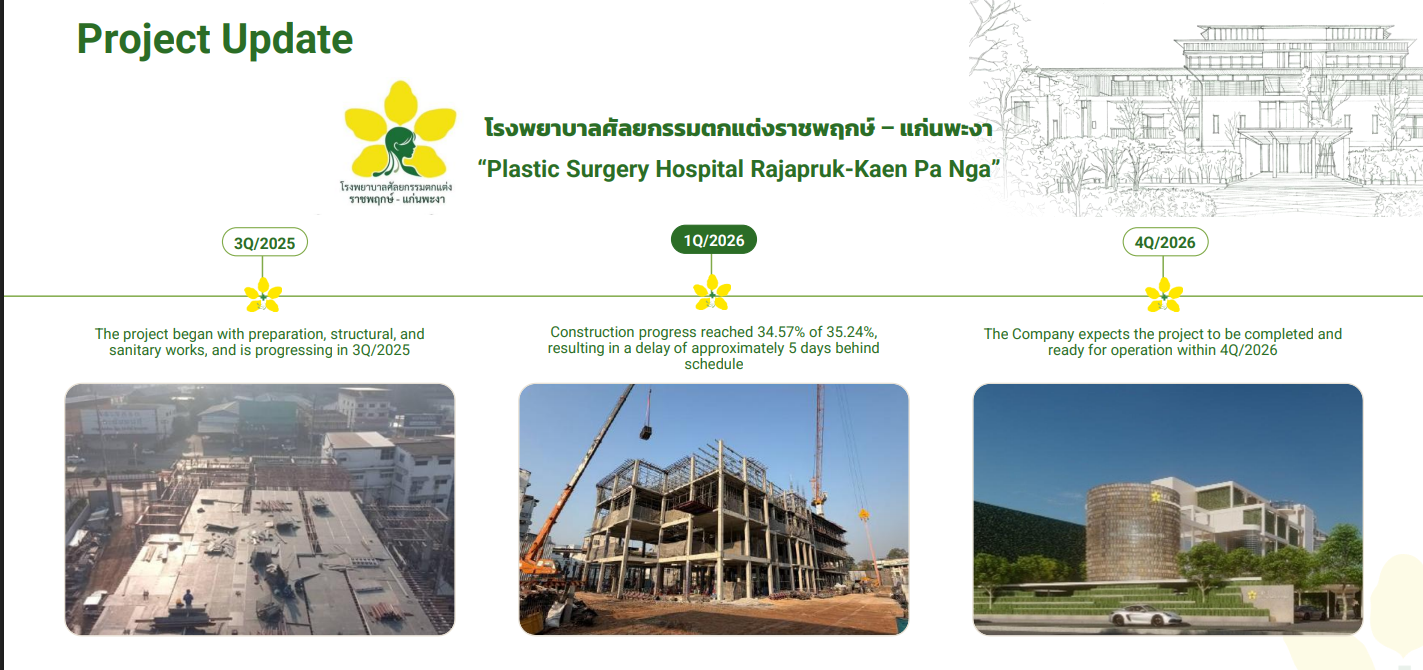
The Company plans to expand its business by establishing a new specialty hospital focusing on aesthetic and cosmetic surgery. During the initial phase of operations, the project may face challenges in generating revenue sufficient to cover operating costs and expenses.
However, the Company believes that this project has strong growth potential due to the increasing demand for aesthetic and cosmetic procedures. The new specialty hospital is expected to serve patients in Khon Kaen, nearby provinces, as well as international clients.
This investment is anticipated to create significant financial opportunities in the long term, as the new facility aims to address key pain points in the aesthetic surgery market and respond to the growing demand for high-quality cosmetic medical services in the region.
2) Enhancing Operational Efficiency
The Company continuously focuses on improving operational processes across multiple dimensions to enhance service efficiency and create a stronger competitive advantage. These improvements include:
Strengthening healthcare quality and patient safety standards
Enhancing patient experience to create distinctive and memorable service delivery
Promoting holistic healthcare services with a patient-centered approach
Such developments are expected to increase patient confidence and support the Company’s sustainable growth.
3) Marketing Strategy and Patient Base Expansion
Effective marketing strategies and brand awareness initiatives are important factors supporting the Company’s growth. The Company emphasizes proactive marketing strategies to expand its patient base both domestically and internationally, while maintaining strong relationships with existing patients.
In addition, the Company utilizes both traditional and digital communication channels to increase accessibility to target customer groups and strengthen brand recognition of the hospital.
External Factors
1) Economic Conditions and Industry Competition
Economic fluctuations at both domestic and global levels may affect consumer purchasing power and intensify competition within the private healthcare industry, which may impact the Company’s revenue in the short term.
Nevertheless, the demand for healthcare services continues to grow, particularly due to the aging population and increasing health awareness among the public.
2) Uncertainty in Government Policies and Political Conditions
Changes in government policies and political conditions may affect the overall business environment and operations of private sector organizations, including healthcare providers.
The Company closely monitors such developments and adjusts its business strategies accordingly to ensure stable and sustainable operations.