

CG Structure · 2025
In this section20 topics
- Board Composition9 items
- Board of Directors1 item
- Board Meetings & Remuneration5 items
- Balance of Power Between the Board and Management4 items
- Board Roles, Duties and Charter5 items
- Other Board Governance Matters1 item
- Subcommittees — Overview2 items
- Audit Committee6 items
- Other Subcommittees2 items
- Executives4 items
- Executive Remuneration5 items
- Remuneration Policy5 items
- Employees3 items
- Employee Remuneration2 items
- Provident Fund5 items
- Policy for Employees Not in the Provident Fund6 items
- Auditors and Audit Fees7 items
- Company Secretary and Other Assigned Persons7 items
- Investor Relations Contact3 items
- Representatives in Thailand (Foreign Companies)1 item
Board Composition
Board Composition — Introduction
Board Composition
The Company’s Board of Directors consists of a total of 10 directors, representing 100.00% of the entire Board, with the following composition:
Male directors: 7 persons, representing 70.00%
Female directors: 3 persons, representing 30.00%
This composition reflects a certain level of gender diversity and forms part of the Company’s commitment to good corporate governance. The Board plays a key role in determining the Company’s direction and strategy, as well as overseeing its operations to ensure transparency, efficiency, and due consideration of the interests of all stakeholder groups.
The Board composition may also be classified according to director status as follows:
Executive directors
Non-executive directors
Independent directors
Non-executive directors who are not independent directors
Board Diversity and Governance
The Company places importance on Board diversity in various dimensions, particularly in terms of gender, knowledge, expertise, and experience, in order to ensure that policy formulation and corporate oversight are carried out in a comprehensive and balanced manner. The composition of the Board, with female directors accounting for 30.00%, reflects the Company’s commitment to promoting diversity and equality at the Board level, which is one of the key elements of good corporate governance.
In this regard, the Company considers directors’ qualifications based on the principles of appropriateness, independence, and capability to perform their duties in the best interests of the Company and all stakeholders. The Board is responsible for setting strategic direction, overseeing risk management, and closely monitoring management’s performance in order to support the Company’s sustainable long-term growth.
Total Number of Directors
10
Male Directors
7
Female Directors
3
Independent Directors
5
Non-executive Directors
9
Non-executive Directors Who Are Not Independent
4
Executive Directors
1
Total Board Meetings Held
4
Board of Directors
Directors
| Title | First Name | Last Name | Gender | Year of Birth | Nationality | Resident in Thailand? | Position | Executive or Non-executive | Independent Director? | Director Type | Appointment Date | Authorised to Sign? | Related to Another Director or Executive? | Any Legal Violation in the Past 5 Years? | Highest Education | Field of Study | Field of Study — Please Specify | Skills & Expertise | Director Training | Attended Director Training? | Director Accreditation Program (DAP)? | Director Certification Program (DCP)? | Board Meetings Held | Board Meetings Attended | AGMs Held | AGMs Attended | Meeting Allowance (Baht) | Other Remuneration (Baht) | Total Remuneration (Baht) | Non-monetary Remuneration | Shares Held | Shareholding (%) | Shares Held by Related Persons (s.59) | Shareholding by Related Persons (s.59, %) | Indirect Shareholding (held by whom) | Shareholding Details (URL) |
|---|---|---|---|---|---|---|---|---|---|---|---|---|---|---|---|---|---|---|---|---|---|---|---|---|---|---|---|---|---|---|---|---|---|---|---|---|
| Mr. | SUDHON | SRIYAPANT | M | 1,946 | 643 · Description: Thailand | Y | Chairman of the board | Non-executive | N | Continuing director (Full term of directorship and being re-appointed as a director) | 2021-02-20T00:00 | Y | N | N | Master's degree | Business Administration | 158 · Description: Corporate Management · 163 · Description: Leadership · 265 · Description: Governance/ Compliance · 1683 · Description: Business Administration | 1730 · Year: 2003 · Description: Director Accreditation Program (DAP) · 1736 · Year: 2023 · Description: Role of the Chairman Program (RCP) | Y | Y | N | 4 | 4 | 1 | 1 | 68,400 | 360,000 | 428,400 | 0 | 8,800,810 | 1.61 | 58,153,000 | 10.65 | Spouse and children | https://investor.rph.co.th/storage/document/major-shareholders/report-of-changes-in-securities-holding-of-directors-and-executives-2025-th.pdf | |
| Mr. | VALLOP | LAOPAIBOON | M | 1,956 | 643 · Description: Thailand | Y | Vice Chairman | Non-executive | N | Continuing director (Full term of directorship and being re-appointed as a director) | 2016-09-09T00:00 | Y | N | N | Bachelor's degree | Medicine | 134 · Description: Health Care Services · 163 · Description: Leadership | 1730 · Year: 2017 · Description: Director Accreditation Program (DAP) | Y | Y | N | 4 | 4 | 1 | 1 | 57,000 | 360,000 | 417,000 | 0 | 24,459,960 | 4.48 | 111,544,100 | 20.43 | Spouse and children | https://investor.rph.co.th/storage/document/major-shareholders/report-of-changes-in-securities-holding-of-directors-and-executives-2025-th.pdf | |
| Mr. | TEERAWAT | SRINAKARIN | M | 1,957 | 643 · Description: Thailand | Y | Director | Executive | Existing director | 1993-04-16T00:00 | Y | Y | N | Bachelor's degree | Medicine | 134 · Description: Health Care Services · 163 · Description: Leadership · 158 · Description: Corporate Management · 145 · Description: Corporate Social Responsibility | Y | Y | Y | 4 | 4 | 1 | 1 | 57,000 | 360,000 | 417,000 | 0 | 66,175,100 | 12.12 | 14,392,680 | 2.64 | Spouse and children | https://investor.rph.co.th/storage/document/major-shareholders/report-of-changes-in-securities-holding-of-directors-and-executives-2025-th.pdf | |||
| Mr. | SRICHAI | KRUSUN | M | 1,956 | 643 · Description: Thailand | Y | Director | Non-executive | N | Existing director | 1993-04-16T00:00 | Y | N | N | Bachelor's degree | Medicine | 134 · Description: Health Care Services · 163 · Description: Leadership | 1730 · Year: 2017 · Description: Director Accreditation Program (DAP) | Y | Y | N | 4 | 4 | 1 | 1 | 57,000 | 360,000 | 417,000 | 0 | 7,000,000 | 1.28 | 0 | 0 | https://investor.rph.co.th/storage/document/major-shareholders/report-of-changes-in-securities-holding-of-directors-and-executives-2025-th.pdf | ||
| Mr. | SUPHAN | SRITHAMMA | M | 1,956 | 643 · Description: Thailand | Y | Director | Non-executive | N | Existing director | 1993-04-16T00:00 | N | N | N | Bachelor's degree | Medicine | 134 · Description: Health Care Services · 145 · Description: Corporate Social Responsibility · 158 · Description: Corporate Management · 3173 · Description: Public Administration | 1730 · Year: 2017 · Description: Director Accreditation Program (DAP) | Y | Y | N | 4 | 4 | 1 | 1 | 57,000 | 360,000 | 417,000 | 0 | 2,400,000 | 0.44 | 0 | 0 | https://investor.rph.co.th/storage/document/major-shareholders/report-of-changes-in-securities-holding-of-directors-and-executives-2025-th.pdf | ||
| Mr. | VORATHEP | RANGCHAIKUL | M | 1,961 | 643 · Description: Thailand | Y | Director | Non-executive | Y | Existing director | 2021-02-12T00:00 | N | N | N | Master's degree | Management | 142 · Description: Marketing · 164 · Description: Strategic Management · 1683 · Description: Business Administration | 1727 · Year: 2023 · Description: Advanced Audit Committee Program (AACP) | Y | Y | Y | 4 | 4 | 1 | 1 | 57,000 | 360,000 | 417,000 | 0 | 4,530,000 | 0.83 | 0 | 0 | https://investor.rph.co.th/storage/document/major-shareholders/report-of-changes-in-securities-holding-of-directors-and-executives-2025-th.pdf | ||
| Ms. | SIRIKUL | LAUKAIKUL | F | 1,959 | 643 · Description: Thailand | Y | Director | Non-executive | Y | Continuing director (Full term of directorship and being re-appointed as a director) | 2024-02-17T00:00 | N | N | N | Doctoral degree | other | Human resource development | 147 · Description: Sustainability · 146 · Description: Human Resource Management · 155 · Description: Brand Management | 1730 · Year: 2016 · Description: Director Accreditation Program (DAP) | Y | Y | Y | 4 | 2 | 1 | 1 | 27,000 | 360,000 | 387,000 | 0 | 0 | 0 | 0 | 0 | ||
| Mr. | VAIROJ | JINDAMANEEPITAK | M | 1,961 | 643 · Description: Thailand | Y | Director | Non-executive | Y | Existing director | 2024-04-22T00:00 | N | N | N | Master's degree | Accounting | 143 · Description: Accounting · 166 · Description: Audit | 1727 · Year: 2024 · Description: Advanced Audit Committee Program (AACP) · 3280 · Year: 2025 · Description: Board’s Roles in Purpose-driven Transition (PDT) | Y | Y | Y | 4 | 4 | 1 | 1 | 57,000 | 180,000 | 237,000 | 0 | 0 | 0 | 0 | 0 | https://investor.rph.co.th/storage/document/major-shareholders/report-of-changes-in-securities-holding-of-directors-and-executives-2025-th.pdf | ||
| Ms. | ORAWAN | SIRIRATTANAWONG | F | 1,961 | 643 · Description: Thailand | Y | Director | Non-executive | Y | Existing director | 2024-04-22T00:00 | N | N | N | Bachelor's degree | Accounting | 166 · Description: Audit · 143 · Description: Accounting | 1730 · Year: 2024 · Description: Director Accreditation Program (DAP) | Y | Y | N | 4 | 4 | 1 | 1 | 57,000 | 360,000 | 417,000 | 0 | 600,000 | 0.11 | 0 | 0 | https://investor.rph.co.th/storage/document/major-shareholders/report-of-changes-in-securities-holding-of-directors-and-executives-2025-th.pdf | ||
| Mrs. | TINA | SINGHSACHA | F | 1,971 | 643 · Description: Thailand | Y | Director | Non-executive | Y | Existing director | 2024-04-22T00:00 | N | N | N | Master's degree | Finance | 119 · Description: Finance & Securities · 144 · Description: Finance | 1735 · Year: 2024 · Description: Risk Management Program for Corporate Leaders (RCL) · 3280 · Year: 2025 · Description: Board’s Roles in Purpose-driven Transition (PDT) · 1730 · Year: 2019 · Description: Director Accreditation Program (DAP) · 1731 · Year: 2019 · Description: Director Certification Program (DCP) | Y | Y | Y | 4 | 4 | 1 | 1 | 57,000 | 360,000 | 417,000 | 0 | 600,000 | 0.11 | 0 | 0 | https://investor.rph.co.th/storage/document/major-shareholders/report-of-changes-in-securities-holding-of-directors-and-executives-2025-th.pdf |
Board Meetings & Remuneration
Date of the Annual General Meeting
2025-04-23T00:00
Was an Extraordinary General Meeting Held?
No
Board Meeting Allowance (Baht)
551400.0
Other Board Remuneration (Baht)
3420000.0
Total Board Remuneration (Baht)
3971400.0
Balance of Power Between the Board and Management
Balance of Power — Introduction
The Company has established and implemented a policy on the independence of directors as a mechanism to ensure an effective check and balance between the Board of Directors and management. Under this policy, the Lead Independent Director participates in jointly considering and setting the agenda for each Board meeting, thereby enhancing independence, prudence, and transparency in corporate governance. Shareholders and stakeholders may review the profiles and qualifications of the directors on the Company’s Investor Relations website.
In addition, the Company places strong emphasis on the appropriateness and diversity of the Board’s composition. At present, the Board comprises directors with expertise and experience across a wide range of fields, including medical and public health, accounting and finance, economics, industry, marketing, information systems and technology, banking and capital markets, corporate governance, and leadership. Such diversity supports well-rounded deliberation and strategic decision-making.
All Independent Directors are highly experienced individuals with appropriate seniority and professional qualifications and have consistently performed their duties with strict independence from management. During the past year, Independent Directors regularly attended Board meetings and played a key role in providing independent views, oversight, and effective checks and balances in the Board’s decision-making process, for the best interests of the Company and all stakeholders.
Authorized Directors to Bind the Company
Mr. Teerawat Srinakarin, Mr. Vallop Laopaiboon, Mr. Srichai Krusun, and Mr. Sudhon Sriyapant, any two of whom shall jointly sign and affix the Company’s seal, shall have the authority to bind the Company.
Are There Measures Balancing the Board's and Management's Power?
Yes
Measures Balancing the Board's and Management's Power
Board Balance
Mr. Sudhon Sriyapant serves as Chairman of the Board and is not an Independent Director. Nevertheless, the Board has established a governance structure that ensures an appropriate balance of power and effective oversight. The majority of the Board consists of non-executive directors, which supports independent supervision of management’s performance and decision-making.
To further strengthen the checks and balances between the Board of Directors and management, the Board has appointed the Chairman of the Audit Committee as the Lead Independent Director. In this capacity, the Lead Independent Director participates in jointly setting the agenda for Board meetings, thereby enhancing independence, transparency, and the effectiveness of the Board’s governance role.
Separation of Roles and Responsibilities Between the Board of Directors and Management
The Company has clearly defined the roles and responsibilities of the Board of Directors and management. The Board of Directors is responsible for formulating policies and overseeing management, while management is responsible for executing business operations in accordance with the established policies.
As a result, the Chairman of the Board and the Chief Executive Officer (CEO) are not the same person.
Checks and Balances Mechanism
Additionally, the Board of Directors encourages non-executive directors, independent directors, and Audit Committee members to hold private discussions, as appropriate, to deliberate on key management-related matters without the presence of executive directors and/or management. The outcomes of such discussions are subsequently reported to the Chairman of the Board after each session to ensure appropriate follow-up and governance oversight.
In 2025, the Board of Directors held one meeting without executive directors and/or management in attendance on 23 April 2025, as part of its efforts to enhance independence and strengthen checks and balances in the Company’s corporate governance framework.
Methods Used to Balance Power
| Method |
|---|
| Appointment of an independent director Participate in determining the meeting agenda for the committee |
Board Roles, Duties and Charter
Board Roles and Duties — Introduction
The Board of Directors serves as the Company’s principal governance mechanism, with a focus on maintaining an appropriate balance between strategic direction, risk oversight, and monitoring of management performance. The Board’s role is to ensure that the Company operates efficiently, transparently, and in alignment with its long-term objectives and the interests of shareholders and other stakeholders.
In practice, the key roles and responsibilities of the Board include:
Setting the Company’s strategic direction, policies, and operational framework, with due consideration of sustainability, risk management, and long-term stakeholder impacts.
Regularly monitoring and evaluating management’s performance through structured reporting, key performance indicators, and in-depth deliberations at Board meetings.
Ensuring that management decisions are made within clearly defined authority limits, while avoiding undue involvement in day-to-day operations.
Overseeing the Company’s risk management and internal control systems to ensure that material risks are appropriately identified, assessed, and managed.
Promoting good corporate governance, ethical business conduct, regulatory compliance, and the proper management of conflicts of interest.
Maintaining effective checks and balances between the Board and management through the Board’s structure, the presence of independent directors, and meeting processes that facilitate open and independent discussions.
Does the Company Have a Board Charter?
Yes
Content of the Board Charter
The Board of Directors is responsible for the following duties and obligations.
1) Perform duties with responsibility, diligence, and integrity, ensuring compliance with laws, the Company’s objectives, regulations, and shareholder resolutions.
2) Approve the appointment of qualified individuals who do not have disqualifications under the Public Limited Companies Act, B.E. 2535 (1992), the Securities and Exchange Act, B.E. 2535 (1992), and related regulatory announcements and rules to fill Board vacancies other than those resulting from term expiration.
3) Appoint subcommittees from among the Board members and define their scope of authority, duties, and responsibilities.
4) Appoint independent directors and audit committee members, ensuring compliance with the eligibility criteria under securities and exchange laws and relevant Stock Exchange of Thailand (SET) regulations, or propose such appointments for shareholder approval.
5) Approve and amend the names of directors with authority to legally bind the Company.
6) Delegate authority to individuals to carry out Company operations under the Board’s supervision, including specifying the scope and duration of such delegation. The Board retains the right to revoke, amend, or modify such authority.
7) Approve asset acquisitions and disposals, except in cases where shareholder approval is required, in accordance with relevant SET regulations and guidelines.
8) Approve related-party transactions, except where such transactions require shareholder approval, ensuring compliance with SET regulations.
9) Approve interim dividend payments when the Company has sufficient profits, with a report to shareholders at the next general meeting.
10) Define the company's vision, policies, operational direction, business strategy, and annual budget, and oversee the management to ensure implementation in accordance with the established policies, efficiently and effectively, to maximize economic value for shareholders and ensure sustainable growth.
11) Evaluate the performance and remuneration of directors and senior executives.
12) Responsible for the performance and duties of the management, with dedication and caution in the execution of tasks.
13) Oversee the management to ensure that the risk management system is appropriate and effective.
14) Define clear and measurable business goals to guide performance evaluation, considering feasibility and rationality.
15) Regularly be accountable to shareholders, operate in a manner that protects the interests of shareholders, and disclose material information to investors accurately, completely, with high standards, and transparency.
16) Review and determine compensation for senior executives.
17) Monitor the effectiveness of the Company’s risk management framework.
18) Make decisions on significant matters, such as business policies, major investments, executive powers, asset transactions, and legal requirements.
19) Define authorization levels for transactions and Company operations, ensuring compliance with laws, with periodic reviews at least once a year.
20) Ensure the Company maintains a reliable accounting, financial reporting, and audit system, along with internal controls that are regularly assessed for effectiveness.
21) Approve the appointment of external auditors and determine annual audit fees, submitting the proposal for shareholder approval.
22) Publish the Board of Directors' responsibility statement for financial reporting alongside the auditor’s report in the Company’s annual report, covering key governance principles set by the Stock Exchange of Thailand (SET).
23) Supervise the performance of subcommittees to ensure compliance with their respective charters.
24) Conduct self-assessments and overall Board performance evaluations.
25) Review and update the Board and subcommittee charters annually or whenever significant changes occur.
26) Ensure the Company has whistleblowing channels for stakeholders to report misconduct, including mechanisms to address issues and protect whistleblowers from retaliation.
27) Maintain effective communication channels with shareholders and ensure accuracy, completeness, transparency, reliability, timeliness, and compliance with the relevant regulatory guidelines.
28) Promote innovation, technology adoption, and service excellence to enhance medical and healthcare services, meeting patient and stakeholder expectations. This includes responsible business practices, IT governance, and data security measures to improve operational efficiency and competitiveness.
29) Foster strong relationships between executive and non-executive directors, as well as between the Board and management.
30) Establish a comprehensive risk management policy and ensure continuous risk assessment and mitigation.
Link to the Board Charter
https://investor.rph.co.th/storage/document/cg/board-of-directors-charter-th.pdf
Page in the Report
1-9
Other Board Governance Matters
Board Governance Practices
| Practice | Yes / No | Remark |
|---|---|---|
| The chairman of the board and the highest-ranking executive are from the same person | N | |
| The chairman of the board is an independent director | N | |
| The chairman of the board and the highest-ranking executive are from the same family | N | |
| Chairman is a member of the executive board or taskforce | N | |
| The company appoints at least one independent director to determine the agenda of the board of directors’ meeting | Y | The Chairman of the Audit Committee jointly formulates the meeting agenda with the Chairman of the Board of Directors. |
Subcommittees — Overview
Subcommittees — Introduction
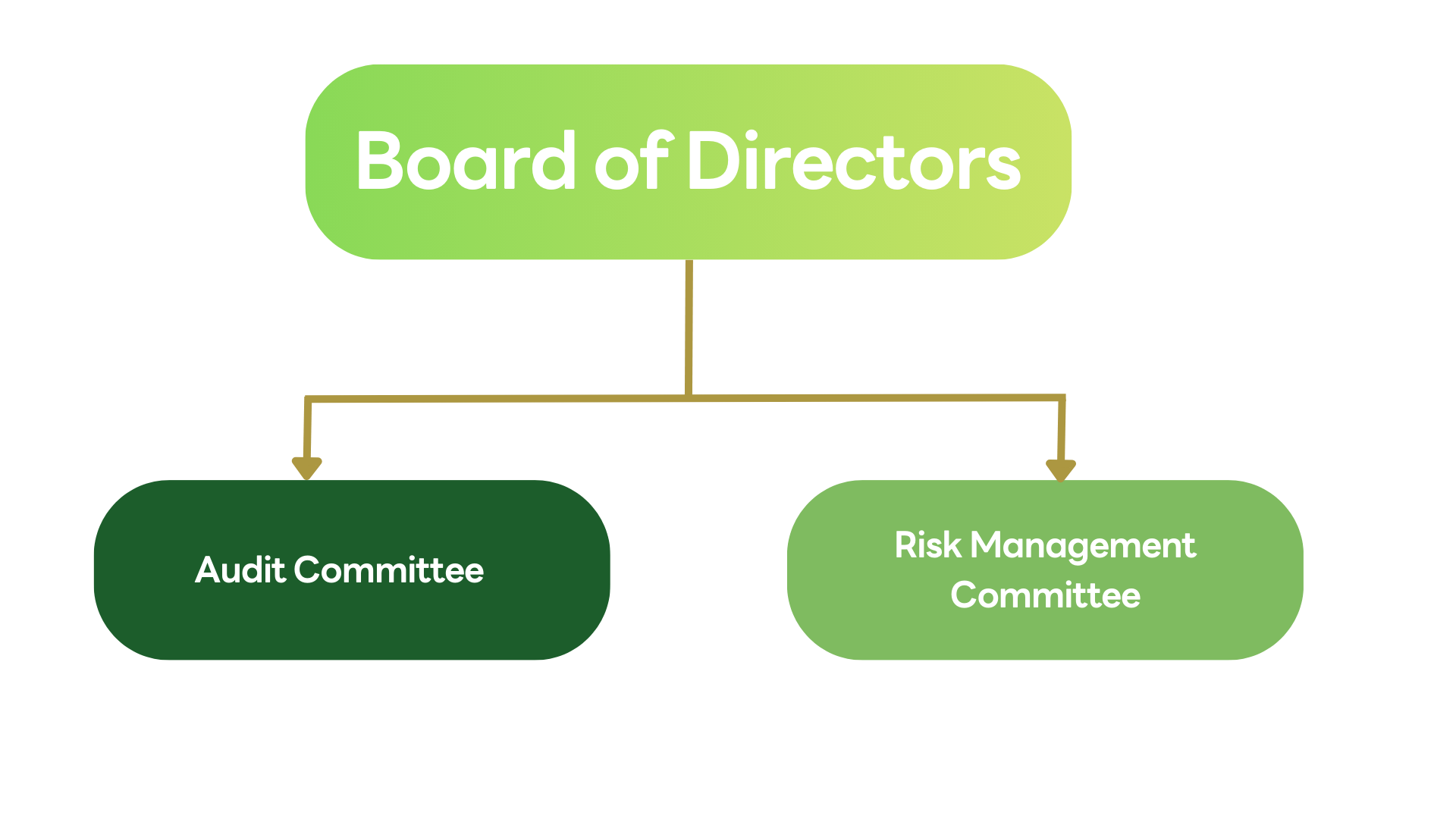
As of December 31, 2025, the structure of the Board of Directors consists of 2 sub-committees: the Audit Committee and The Risk Management Committee.
Roles of the Subcommittees — Introduction
To ensure effective, transparent, and accountable corporate governance, the Board of Directors has established Board committees to review and oversee specific key matters. Each Board committee performs its duties within the scope of authority delegated by the Board of Directors and regularly reports its activities and recommendations to the Board of Directors.
Audit Committee
Audit Committee — Introduction
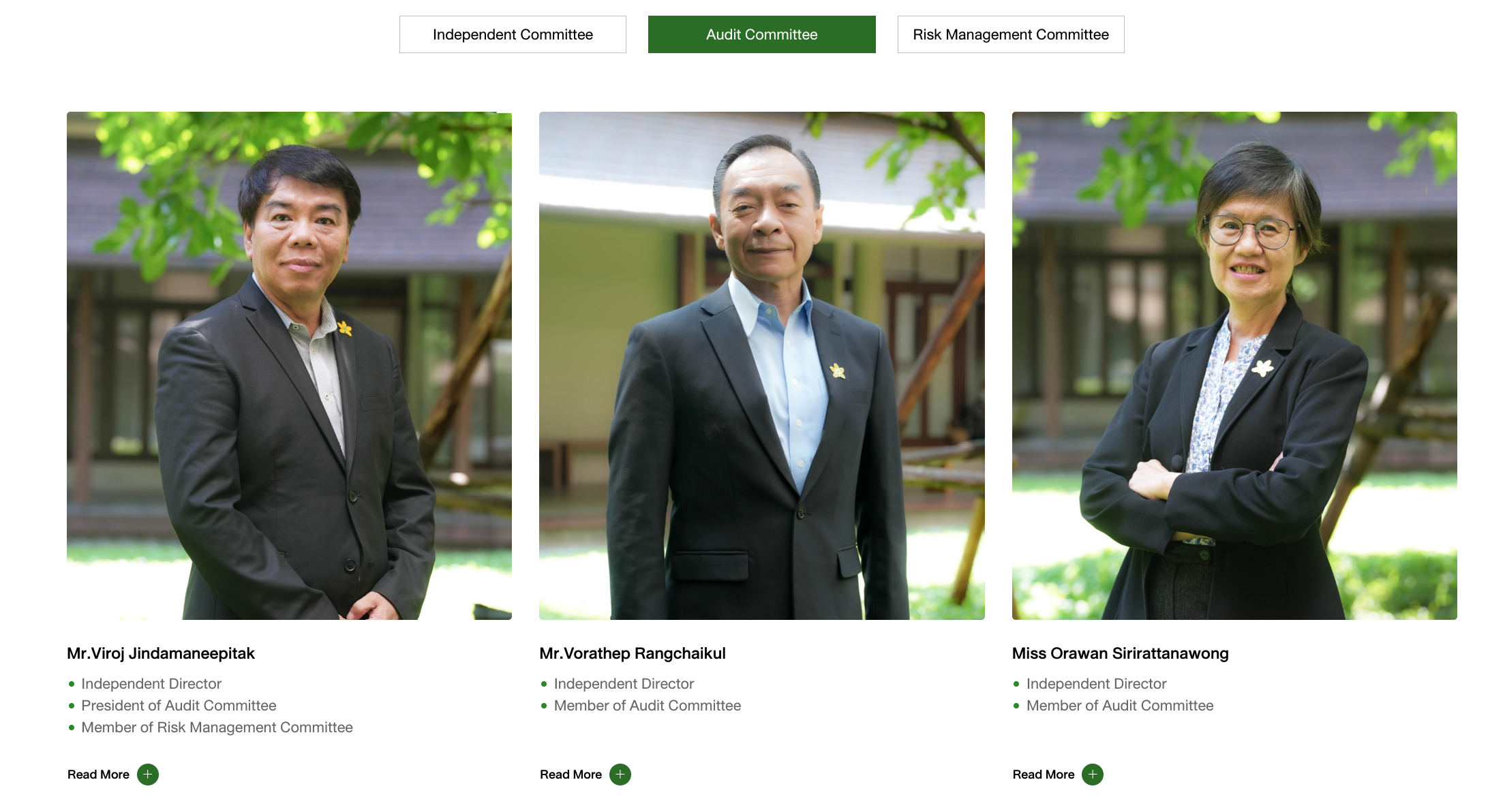
Audit Committee
The Audit Committee has been established with the approval of the Board of Directors to serve as an independent mechanism supporting the Board in promoting and upholding good corporate governance. Its role is to help ensure that the Company’s operations are conducted in accordance with the Code of Conduct, that the internal control system is properly maintained, and that conflicts of interest and corruption are effectively prevented. In addition, the Audit Committee monitors the accuracy and reliability of the accounting system, the internal audit system, and the financial reporting process.
The Audit Committee must consist of at least three members, all of whom must be independent directors of the Company. At least one member must possess sufficient knowledge, understanding, or experience in accounting, finance, or auditing to review the credibility of the financial statements. Other desirable qualifications include business experience, expertise relevant to the Company’s operations, and integrity in the performance of duties.
Term of Office of the Audit Committee
The term of office of each Audit Committee member is aligned with the term of office of the Board of Directors, which is three years. Members who retire by rotation are eligible for re-election.
The Company does not impose a fixed limit on consecutive terms for independent directors, provided that they continue to meet the independence criteria prescribed by the Capital Market Supervisory Board and the Company, and are able to express independent opinions in Board meetings without influence from management or major shareholders. If an independent director serves for more than nine years and the Board of Directors considers it appropriate to propose his or her reappointment, the Board will provide supporting reasons for shareholders’ consideration at the Annual General Meeting (AGM).
In addition, the Board of Directors encourages non-executive directors, independent directors, and Audit Committee members to hold private meetings, as necessary, to discuss key management matters without the presence of executives. The outcomes of such meetings are then reported to the Chairman of the Board after each session.
In 2025, the Audit Committee, comprising independent directors, held a private meeting without the presence of executive directors or management on November 7, 2025.
Audit Committee Charter
| Roles, Duties and Responsibilities | Type of Subcommittee | Link to the Charter | Page in the Report |
|---|---|---|---|
Scope of Authority, Duties, and Responsibilities of the Audit Committee
At the Board of Directors’ Meeting No. 4/2022 on November 5, 2022, the Board reviewed the Charter of the Audit Committee to ensure it remains up to date and aligned with current conditions, legal requirements, and best practices for listed companies.
As a result, the Board resolved to revise the Audit Committee's Charter and define its scope of authority, duties, and responsibilities.
1.Review the accuracy and adequacy of the Company’s financial reporting.
2.Ensure the Company has an effective internal control and internal audit system, while assessing the independence of the internal audit unit. Approve the appointment, transfer, or termination of the Head of Internal Audit or any related auditing function.
3.Ensure the Company complies with securities and exchange laws, Stock Exchange of Thailand (SET) regulations, and other relevant business laws.
4.Select, nominate, and propose the appointment of an independent external auditor, determine their remuneration, and hold meetings with the auditor at least once a year without management present.
5.Review related-party transactions and potential conflicts of interest to ensure compliance with SET regulations and legal requirements, ensuring such transactions are reasonable and beneficial to the Company.
6.Prepare an Audit Committee Report for disclosure in the annual report, signed by the Chairman of the Audit Committee, containing at least the following items:
(1) Opinion on the accuracy, completeness, and reliability of the Company’s financial reports.
(2) Opinion on the adequacy of the Company’s internal control system.
(3) Opinion on compliance with the Securities and Exchange Act of Thailand.
(4) Compliance with the Stock Exchange of Thailand (SET) regulations or other laws related to the Company’s business.
(5) Opinion on the appropriateness of the external auditor.
(6) Opinion on transactions that may involve conflicts of interest.
(7) Number of Audit Committee meetings held and the attendance of each committee member.
(8) Overall opinions or observations from the Audit Committee’s performance under its charter.
(9) Other matters that shareholders and general investors should be informed of, within the scope of duties and responsibilities assigned by the Board of Directors.
7.Perform any additional duties as assigned by the Board of Directors, with the Audit Committee’s consent. | 3091 · Description: Audit of financial statements and internal controls | https://investor.rph.co.th/storage/document/cg/audit-committee-charter-th.pdf | 1-7 |
Audit Committee Members
| Title | First Name | Last Name | Position | Gender | Year of Birth | Nationality | Resident in Thailand? | Appointment Date | Highest Education | Field of Study | Has Accounting or Financial Expertise? | Skills & Expertise | Meetings Held | Meetings Attended | Meeting Allowance (Baht) | Other Remuneration (Baht) | Total Remuneration (Baht) | Non-monetary Remuneration |
|---|---|---|---|---|---|---|---|---|---|---|---|---|---|---|---|---|---|---|
| Mr. | VAIROJ | JINDAMANEEPITAK | Chairman of the audit committee | M | 1,961 | 643 · Description: Thailand | Y | 2024-04-22T00:00 | Master's degree | Accounting | Y | 143 · Description: Accounting · 166 · Description: Audit | 4 | 4 | 68,400 | 0 | 68,400 | 0 |
| Ms. | ORAWAN | SIRIRATTANAWONG | Audit committee | F | 1,961 | 643 · Description: Thailand | Y | 2024-04-22T00:00 | Bachelor's degree | Accounting | Y | 166 · Description: Audit · 143 · Description: Accounting | 4 | 4 | 57,000 | 0 | 57,000 | 0 |
| Mr. | VORATHEP | RANGCHAIKUL | Audit committee | M | 1,961 | 643 · Description: Thailand | Y | 2021-02-12T00:00 | Master's degree | Management | N | 142 · Description: Marketing · 164 · Description: Strategic Management · 1683 · Description: Business Administration | 4 | 4 |
Audit Committee — Meeting Allowance (Baht)
125400.0
Audit Committee — Other Remuneration (Baht)
0.0
Audit Committee — Total Remuneration (Baht)
125400.0
Other Subcommittees
Other Subcommittees — Introduction
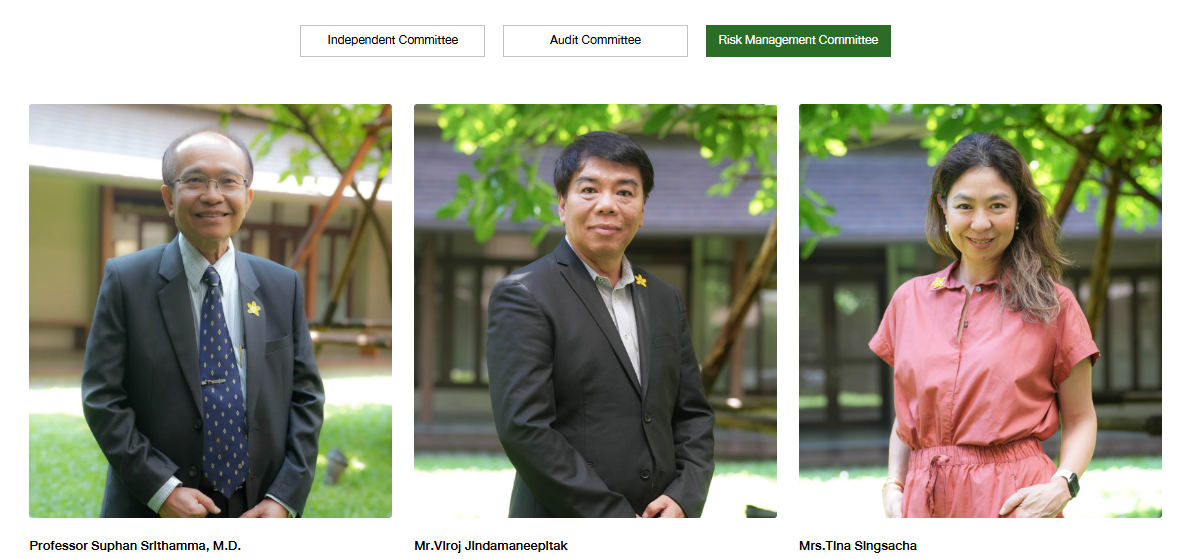
Risk Management Committee
The Board of Directors assigns the Risk Management Committee to oversee the overall risk management process of the organization and investment risks and make sure that it is effective and efficient. In addition, the Risk Management Committee Charter has been prepared to set a framework for risk management operations, including the precise scope of powers, duties, and responsibilities of the Risk Management Committee which helps the Risk Management Committee perform its duties effectively as assigned.
Term of Office for the Risk Management Committee
The term of office for each Risk Management Committee member is aligned with the Board of Directors' term, which is 3 years. Members who retire at the end of their term are eligible for re-election
Other Subcommittees
| Subcommittee Name | Type of Subcommittee | Roles, Duties and Responsibilities | Link to the Charter | Page in the Report | Meetings Held | Subcommittee Remuneration | Members |
|---|---|---|---|---|---|---|---|
| Risk Management Committee | 3092 · Description: Risk management | 1) Determine the risk management policy and framework for the Board of Directors’ consideration and approval.
2) Continuously monitor and develop the Company’s and its subsidiaries’ risk management frameworks and risk management processes to comply with the international standards. The Audit Committee independently reviews the risk management system to ensure that the system is appropriately implemented.
3) Regularly assess, analyze, review, and advise on the Company’s and its subsidiaries’ risks and risk management in normal circumstances and crises.
4) Consider and provide comments on the Company’s risk appetite and risk assessment criteria.
5) Acknowledge and provide comments on the adequacy and appropriateness of the risk assessment results and risk mitigation.
6) Ensure that the risk management complies with the risk management framework.
7) Regularly report the Company’s significant risk assessment, risk mitigation, and improvement to the Board of Directors.
8) Encourage cooperation in risk management within the Company and its subsidiaries.
9) Supervise and support the operation of the risk management department to be aligned with the Company’s policies and objectives.
10) Communicate and exchange risk assessment and risk mitigation with the Audit Committee at least once a year.11) Provide comments and recommendation
s on the use of external advisors regarding risk management framework, scope, and implementation.
12) Provide comments and recommendations on the use of external service providers when the risk management department is under-resourced.
13) Carry out any tasks related to risk management assigned by the Board of Directors.
14) Arrange for Risk Management committee to evaluate their own performance (self-assessment) by evaluating both overall and individually at least once a year and reporting the evaluation results to the Board of Directors.
In 2025, the Risk Management Committee regularly held meetings to fulfill its duties and reported the results to the Board of Directors. Details of the Risk Management Committee Performance have been disclosed in the “Risk Management Committee Report”
| https://investor.rph.co.th/storage/document/cg/risk-management-committee-charter-th.pdf | 1-6 | 2 | 86400.0 · Meeting allowance: 86400.0 · Other remuneration: 0.0 | 260 · Last name: SRITHAMMA · Position: 37 · First name: SUPHAN · Total meeting: 2 · Meeting allowance: 32400.0 · Other remuneration: 0.0 · Total remuneration: 32400.0 · Total meeting attendance: 2 · Non monetary remuneration: 0 · 260 · Last name: JINDAMANEEPITAK · Position: 39 · First name: VAIROJ · Total meeting: 2 · Meeting allowance: 27000.0 · Other remuneration: 0.0 · Total remuneration: 27000.0 · Total meeting attendance: 2 · Non monetary remuneration: 0 · 262 · Last name: SINGHSACHA · Position: 39 · First name: TINA · Total meeting: 2 · Meeting allowance: 27000.0 · Other remuneration: 0.0 · Total remuneration: 27000.0 · Total meeting attendance: 2 · Non monetary remuneration: 0 |
Executives
Executives — Introduction
Duties and Responsibilities of Executives
The executives are responsible for managing and operating the Company’s business in accordance with the vision, mission, strategies, policies, plans, and objectives approved by the Board of Directors. They are also required to strictly comply with the Company’s regulations, resolutions of the Board of Directors’ meetings, and resolutions of the shareholders’ meetings, in order to ensure that the Company’s operations are conducted efficiently, transparently, and in line with the principles of good corporate governance.
Executives must perform their duties under the framework of the corporate governance policy prescribed by the Board of Directors, including the Company’s code of business ethics and other related practices, so that management is carried out with integrity, transparency, accountability, and with due regard to the best interests of the Company, its shareholders, and all stakeholders.
In addition, executives are responsible for preparing the annual business plan, operational plan, and budget for submission to the Board of Directors for approval. They are also required to supervise and manage the use of resources and budget within the approved framework in an appropriate and effective manner, while regularly reporting the Company’s operating results, progress of the plans, and significant issues that may affect the Company to the Board of Directors in order to support the Board’s oversight, monitoring, and policy decision-making.
As of the date of disclosure in the Annual Registration Statement / Annual Report (Form 56-1 One Report), neither the Board of Directors nor the executives of the Company has any record of legal misconduct during the preceding 10 years.
Names and Positions — Introduction

Highest-ranking Executive — Introduction
As of December 31, 2025, the Company’s management team, as defined by the office of Securities and Exchange Commission (SEC),
Executives
| Title | Title — Please Specify | First Name | Last Name | Position | Gender | Year of Birth | Nationality | Resident in Thailand? | Appointment Date | Highest Education | Field of Study | Field of Study — Please Specify | Skills & Expertise | Is the Highest-ranking Executive? | Is the Highest-ranking Accounting or Finance Officer? | Directly Responsible for Accounting? | Appointed After the End of the Fiscal Year? |
|---|---|---|---|---|---|---|---|---|---|---|---|---|---|---|---|---|---|
| Mr. | TEERAWAT | SRINAKARIN | Chief Executive Offcer | M | 1,957 | 643 · Description: Thailand | Y | 2016-04-16T00:00 | Bachelor's degree | Medicine | 134 · Description: Health Care Services · 163 · Description: Leadership · 158 · Description: Corporate Management · 145 · Description: Corporate Social Responsibility | Y | N | N | N | ||
| other | Assoc.Prof.M.D | JIRAPORN | SRINAKARIN | Chief Medical Officer | F | 1,957 | 643 · Description: Thailand | Y | 2018-01-15T00:00 | Master's degree | Medicine | 134 · Description: Health Care Services · 163 · Description: Leadership | N | N | N | N | |
| Mrs. | Parinya | Sirisaeng | Deputy of Nursing Officer (IPD) | F | 1,974 | 643 · Description: Thailand | N | 2016-02-08T00:00 | Bachelor's degree | other | Nursing Science | 134 · Description: Health Care Services · 163 · Description: Leadership | N | N | N | N | |
| Ms. | SUPAPORN | SUKHEE | Chief Financial Offcer | F | 1,972 | 643 · Description: Thailand | Y | 2021-09-01T00:00 | Bachelor's degree | Accounting | 143 · Description: Accounting · 144 · Description: Finance | N | Y | N | N | ||
| Ms. | Airin | Ngamsombutcharoen | Deputy of Chief Financial Officer | F | 1,987 | 643 · Description: Thailand | Y | 2023-08-01T00:00 | Bachelor's degree | Accounting | 143 · Description: Accounting · 166 · Description: Audit | N | N | N | N | ||
| Ms. | SIREETHORN | PALKIRD | Chief Nursing Officer | F | 1,972 | 643 · Description: Thailand | Y | 2019-06-01T00:00 | Bachelor's degree | other | Nursing Science | 163 · Description: Leadership · 134 · Description: Health Care Services | N | N | N | N | |
| Mrs. | Sumalee | Taen-yuan | Deputy of Nursing Officer (Special Unit) | F | 1,974 | 643 · Description: Thailand | N | 2019-02-01T00:00 | Bachelor's degree | other | Nursing Science | 134 · Description: Health Care Services | N | N | N | N | |
| other | Dr. | Weerad | Trongtranont | Chief Information Officer | F | 1,993 | 643 · Description: Thailand | Y | 2022-05-01T00:00 | Bachelor's degree | Medicine | 134 · Description: Health Care Services · 150 · Description: IT Management | N | N | N | N | |
| Ms. | Wadcharapron | Wiboon | Chief Human Resource Officer | F | 1,982 | 643 · Description: Thailand | Y | 2024-10-01T00:00 | Bachelor's degree | other | Doctor of Pharmacy | 134 · Description: Health Care Services · 146 · Description: Human Resource Management | N | N | N | N |
Executive Remuneration
Executive Remuneration — Introduction
Director remuneration
Directors’ remuneration is approved at the annual general meeting of shareholders after being considered and submitted by the Board of Directors. The remuneration of directors is comparable to the pay rates in similar organizations in the same industry and commensurate with the roles, responsibilities, experience, and work performance of each director. Directors with additional duties and responsibilities such as serving on sub-committees are eligible for additional remuneration as appropriate.
Executive Compensation
The Company determines executive compensation based on performance evaluations, aligning with both Company performance and individual achievements. Annual performance appraisals are conducted, and the CEO evaluates the appropriateness of executive compensation and annual salary adjustments to reflect each executive's performance and responsibilities under the Company’s vision, mission, and strategy.
The CEO’s compensation is set by the Board of Directors based on transparent, fair, and reasonable criteria, considering responsibilities, performance, short-term and long-term incentives, and Company financial results compared to business plans. The Board also evaluates the CEO’s performance annually to ensure alignment with the Company’s strategic direction and mission.
Management Remuneration
The remuneration for management (same principles as general employees at every level) consists of a salary, contribution to the provident fund, and annual bonus, the amount of which is determined based on the Company’s operating results and the annual work performance of each executive and employee. If performance results achieve the target, employees and executives will receive an annual bonus . Compensation should be similar to that is paid in the same industry.
Work Performance Evaluation
Appraisal of work performance and compensation management for high-level executives (same principles as general employees at every level) are as follows:
- Step 1 Acknowledge and agree on the annual operational goals so that all can work toward shared enterprise objectives.
- Step 2 When the enterprise objectives are set and acknowledged as each manager’s personal annual work goals, follow-ups are required to see what progress has been made because many different activities may be involved in order to reach such goals.
- Step 3 The level of success in reaching the goals is evaluated on the score of 1 to 5. The evaluation scores for each area are combined and considered to determine the remuneration amount, such as annual bonus, and salary raised. Other components, like the level of participation in achieving business goals and the Company’s values are also taken into consideration.
Evaluation of goal achievements and work performances for both high-level executives and general employees includes evaluations by executive and supervisors to score their success and achievement. The subordinates also evaluate the work performances of supervisors. After that, the Human Resources department will combine the data and compare it to get an accurate and verifiable guideline to be forwarded to the supervisors for scoring and evaluating work performances of executives and employees'
Management Compensation Structure
1) Base Compensation
The level of base compensation is determined with reference to responsibilities, job characteristics, experience, and competencies required for each position. The Company pays salaries on a monthly basis through bank transfer. Base compensation is reviewed annually, and any adjustment is determined based on individual performance as well as relevant market benchmarks.
2) Annual Bonus
The annual bonus is determined based on performance against annual targets and by reference to relevant market remuneration benchmarks. Such bonus is linked to annual Key Performance Indicators (KPIs), which are used to assess both the Company’s overall performance and individual performance, and to determine bonus awards accordingly.
3) Other Benefits or Compensation
Other benefits consist of the provident fund, health check-ups and medical treatment, the social security fund, and other benefits provided in accordance with labor market practices and applicable laws.
For the year ended December 31, 2025, the Company paid total compensation to executives in the amount of Baht 548,473. Such compensation includes salary, bonus, provident fund contributions, other welfare benefits, and post-employment benefits.
Monetary Remuneration — Description
Details of Directors’ Remuneration for the Year 2025
Monetary Remuneration
Monthly Remuneration
Directors receive a monthly remuneration of THB 15,000 per person per month.Meeting Allowance
Directors receive a meeting allowance per meeting attended, including meetings of subcommittees, as follows:
Chairman of the Board / Chairman of Subcommittees: THB 18,000 per person per meeting
Director / Subcommittee Member: THB 15,000 per person per meeting
Annual Bonus
Directors are entitled to an annual bonus equivalent to 2% of the total dividend payment, capped at THB 1,800,000.
Non-Monetary Remuneration
Medical welfare and annual health check-up benefits for directors and their families, with a coverage limit of THB 300,000 per person per year.
Directors’ Compensation Paid in 2025 (For Performance Year 2025)
For the year 2025, the Company paid monthly remuneration and meeting allowances to directors in the total amount of Baht 2,620,200, which was within the approved budget of Baht 3,500,000. Such remuneration was paid based on the number of meetings attended and the duration of each director’s tenure.
With respect to the directors’ bonus for 2025, the Company paid a total amount of Baht 1,650,000. The maximum budget was set at not more than 2% of the dividend paid and not exceeding Baht 1,800,000, to be allocated among 10 directors.
As of December 31, 2025, the Company had one subsidiary, namely Kaen Phanga Co., Ltd., which had not yet commenced operations and was under consideration for a capital increase. Accordingly, no remuneration had yet been paid to the directors of such subsidiary.
Note: All directors’ remuneration, both monetary and non-monetary, was approved by the Annual General Meeting of Shareholders held on April 23, 2025.
Monetary Remuneration
| Metric | Current Year | Previous Year | Two Years Ago | Remark |
|---|---|---|---|---|
| Total remuneration of executive directors and executives (baht) | 19,947,585 | 18,140,356 | 16,032,643 | In 2025, one executive will retire. |
| Total remuneration of executive directors (baht) | 4,420,200 | 4,220,400 | 3,773,600 | |
| Total remuneration of executives (baht) | 15,527,385 | 13,919,956 | 12,259,043 | Including the director and CEO positions |
Other Remuneration
| Metric | Current Year | Previous Year | Two Years Ago |
|---|---|---|---|
| Company’s contribution to provident fund for executive directors and executives (Baht) | 70,786.24 | 65,977 | 54,086 |
| Employee Stock Ownership Plan (ESOP) | 0 | 0 | 0 |
| Employee Joint Investment Program (EJIP) | 0 | 0 | 0 |
Remuneration or Benefits Payable to Executives
| Metric | Amount (Baht) | Remark |
|---|---|---|
| Outstanding remuneration or benefits of executive directors and executives in the past year (baht) | 429,624.8 | |
| Estimated remuneration of executive directors and executives in the current year (baht) | 20,566,147.51 | For the year 2026, the Company expects the total remuneration of executive directors and executives to be approximately Baht 20,251,741.00. This amount consists of salary, position allowance, experience allowance, other income, executive bonus, directors’ bonus, meeting allowance, accrued gratuity, and social security contributions. In addition, the Company has long-term employee benefit obligations totaling Baht 314,406.51, comprising employee benefits of Baht 239,975.21 and provident fund contributions of Baht 74,431.30. Accordingly, when including long-term benefits, the total remuneration of executive directors and executives for the year 2026 is approximately Baht 20,566,147.51. |
Remuneration Policy
Executive Remuneration Policy
Director and Senior Executive Remuneration Policy
In the context of rapidly changing business environments, boards of directors of companies listed on the Stock Exchange of Thailand face increasing challenges in determining strategies and business directions that align with evolving economic, social, and industry conditions. In addition, boards are required to strengthen the organization’s ability to adapt and recover (Resilience) in order to ensure business continuity and sustainable growth.
The Board of Directors plays a crucial role in overseeing corporate governance, setting strategic directions, and monitoring the performance of management to ensure effective operations. These responsibilities require extensive knowledge, experience, and a high level of accountability. Therefore, director remuneration is an important consideration in reflecting such responsibilities and in attracting qualified individuals with appropriate expertise and experience to participate in the governance of the Company.
The Board of Directors has therefore established a policy and criteria for determining directors’ remuneration based on the principles of fiduciary duty and good corporate governance practices, ensuring that remuneration is appropriate, transparent, and aligned with the creation of sustainable value for the Company.
Policy on Remuneration of Directors and Senior Executives
The Company has established a remuneration policy for directors and senior executives, including the Board of Directors, the Audit Committee, the Risk Management Committee, and the Chief Executive Officer. The remuneration is determined with consideration of the roles, responsibilities, and performance of each position, as well as the Company’s operating results and relevant business conditions.
In determining remuneration, the Company also considers benchmarking with other companies in the same or similar industries to ensure that the remuneration remains appropriate and competitive. The proposed remuneration structure will be submitted to the Board of Directors and/or the shareholders’ meeting for consideration and approval in accordance with the Company’s governance procedures.
Was an Opinion Obtained from the Board and the Remuneration Committee?
Yes
Opinion of the Board and the Remuneration Committee
Board of Directors’ View on the Reasonableness of the Remuneration Policy
The Board of Directors considers that the Company’s policy on directors’ remuneration is appropriate and aligned with the roles, responsibilities, and strategic direction of the Company. The remuneration framework is determined by benchmarking against companies within the same or comparable industries and is established through a transparent process. This approach enables the Company to attract and retain qualified directors with appropriate knowledge, expertise, and experience to effectively oversee the Company’s operations and create sustainable value for shareholders.
The Board’s consideration is based on four key principles as follows:
1. Remuneration should reflect the roles and responsibilities of directors
The Board recognizes that the roles of directors of listed companies have become increasingly complex, particularly in the areas of:
Business strategy formulation
Risk management
Sustainable corporate governance oversight
Therefore, directors’ remuneration should appropriately reflect their duties, responsibilities, and professional expertise, as well as the value they contribute to the Company and its shareholders.
2. Remuneration should align with the Company’s strategy and performance
The Company’s remuneration policy links directors’ remuneration with:
The Company’s business strategy and objectives
The Company’s performance in both the short and long term
This concept reflects the Board’s view that remuneration should serve as a mechanism to support value creation, rather than merely being limited to meeting allowances or position-based compensation.
3. Remuneration should be competitive with companies in the same industry
The Board considers benchmarking against companies operating in the same or comparable industries within the capital market to ensure that remuneration levels are appropriate and competitive.
This approach allows the Company to:
Attract directors with strong knowledge and experience
Retain capable directors who can contribute to the Company’s long-term development
4. Transparency and shareholder approval
Directors’ remuneration will be:
Disclosed to shareholders
Proposed to the shareholders’ meeting for consideration and approval
This practice reflects a key principle of good corporate governance, aiming to build confidence among shareholders and stakeholders.
Link to the Remuneration Policy
https://investor.rph.co.th/storage/document/cg/policy-and-criteria-for-determining-directors-remuneration-th.pdf
Page in the Report
1-5
Employees
Employees — Introduction
The Company follows an equal employment policy, ensuring a non-discriminatory approach regardless of gender, race, religion, or cultural background. Employees are recognized as valuable assets that drive the Company’s business operations. The full employment policy is available on the Company's Investor Relations website under the Sustainability Development section.
Employees — Sub-section Introduction
As of December 31, 2024, Ratchaphruek Hospital Public Company Limited employed a total of 782 staff members, including employees, and executives.
Any Significant Change in Headcount in the Past 3 Years?
No
Employee Remuneration
Employee Remuneration — Introduction
 The Company's Remuneration Management principles
 are to attract, motivate, and retain potential employees in the organization in order to develop the Company for sustainable growth and create value for shareholders in accordance with the Company's operating principles. The Company's Remuneration Management principles are established to offer fair and competitive remuneration within and outside the Company.
Employee Compensation
The Company has established an employee compensation policy that aligns with both short-term and long-term business performance, ensuring fair and appropriate remuneration. The compensation structure is tailored to each job level, with salaries determined based on performance, responsibilities, expertise, and individual contributions.
Employees receive equitable and fair compensation within the organization while also ensuring that salary adjustments align with economic conditions, inflation rates, the Consumer Price Index (CPI), and industry benchmarks. Employee compensation is structured to reflect the Company’s growth, and employees receive salary, bonuses, and provident fund contributions as part of their total compensation package.
Employee Compensation
(1) Monetary Compensation
The Company determines employee compensation based on job responsibilities and performance. The compensation policy ensures that remuneration is fair and appropriate, aligning with economic factors, cost of living, industry standards, and the Company’s overall performance. Compensation adjustments are reviewed annually in conjunction with performance evaluations.
(2) Non-Monetary Compensation
In addition to fair and appropriate compensation, the Company provides comprehensive benefits, including medical coverage, social security fund, provident fund, healthcare allowances, employee uniforms, and financial assistance in the event of an employee’s death. Employees also receive annual health check-ups for themselves and their parents, flu vaccinations, and financial support in cases of the death of their parents, children, or spouses. The Company also offers financial aid for natural disasters such as floods and fires. Additionally, a 60% medical fee discount is provided for direct family members of employees who receive medical treatment. Employees have the option to pay in installments or deduct the cost from their monthly salary.
Nature of Employee Remuneration
The Company and its subsidiaries provide employee compensation in various forms, as appropriate and in line with the organization’s operating performance. Such compensation covers both direct remuneration and related employee benefits. The comparison of employee compensation (excluding the highest-ranking executive) over the past three years is as follows:
Provident Fund
Does the Company Have a Provident Fund?
Yes
Provident Fund Policy
The Company established a provident fund in 2013 in accordance with the Provident Fund Act B.E. 2530 (1987), as amended, with Bualuang Fund Management Co., Ltd. serving as the fund manager. The fund was established to promote employees’ long-term financial security, enhance morale and encouragement in the workplace, and support employees’ continued long-term service with the organization.
Under this scheme, the Company contributes to the fund at a rate of 2% of each employee’s salary base, while employees may choose to make voluntary contributions at a rate of 2% to 15% of their salary base, depending on their individual savings plans and preferences.
In 2025, a total of 544 employees participated in the provident fund out of 778 total employees, representing 69.92% of the total workforce. The participation rate remained at a consistently high level, close to that of the previous year. In comparison:
In 2023, 464 employees participated, representing 59.56% of total employees.
In 2024, 550 employees out of 784 total employees participated, representing 70.15%.
These figures reflect employees’ awareness of the importance of long-term financial planning, alongside the Company’s commitment to promoting welfare programs that continuously support the long-term financial stability and quality of life of its personnel.
Provident Fund Arrangements — Introduction
In 2025, the Company revised the provident fund conditions to provide employees with greater flexibility and to further promote long-term savings. Employees are now allowed to contribute to the fund at a rate of 2% to 15% of their salary base, depending on their individual preferences and suitability for their personal savings plans, compared with the previous condition under which the contribution rate was fixed at only 2% of the salary base.
In addition, the Company amended the provident fund regulations to allow employees who had previously resigned from the fund to rejoin the fund one more time. Previously, once an employee resigned from the provident fund, he or she was no longer eligible to become a member again.
This improvement reflects the Company’s commitment to enhancing employee welfare in response to employees’ needs, supporting long-term financial planning, and continuously strengthening the financial security of its personnel.
Does the Fund Committee Follow the I Code?
Yes
Contribution Method and Rate
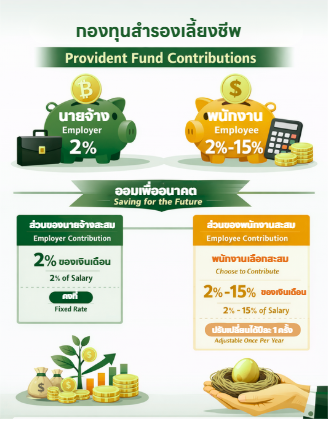
Employees who are members of the Provident Fund and have not withdrawn from membership may request to change their contribution rate. Employees may select a contribution rate ranging from 2% to 15% of their salary. Such contribution rate may be adjusted once per year.
The Company provides a fixed employer contribution of 2% of the employee’s salary, regardless of the employee’s selected contribution rate. Employees are entitled to request a revision of their contribution rate at least once per year in accordance with the Company’s established guidelines.
Policy for Employees Not in the Provident Fund
Automatic Enrolment
Yes
Automatic Enrolment — Details
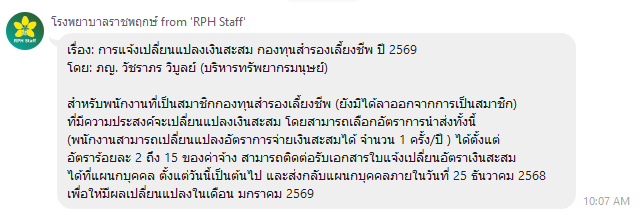
Employees who are members of the Provident Fund and have not withdrawn from membership may request to change their contribution rate. Employees may select a contribution rate ranging from 2% to 15% of their salary. Such contribution rate may be adjusted once per year.
The Company provides a fixed employer contribution of 2% of the employee’s salary, regardless of the employee’s selected contribution rate. Employees are entitled to request a revision of their contribution rate at least once per year in accordance with the Company’s established guidelines.
Encouraging Retirement Saving
Yes
Encouraging Retirement Saving — Details
Policy and Practices to Promote Savings through the Provident Fund (PVD)
for Employees Who Have Not Yet Become Fund Members
The Company recognizes the importance of promoting financial discipline and long-term savings among employees in order to strengthen financial security after retirement. Accordingly, the Company has established guidelines to encourage employees to participate in the Provident Fund (PVD), as follows:
Facilitating Automatic Enrollment for New Employees to encourage employees to begin saving from the start of their employment.
Organizing campaigns and activities to promote savings in order to encourage employees to accumulate sufficient funds for retirement.
Providing knowledge and information on financial planning, including guidance on selecting appropriate investment policies based on employees’ risk tolerance.
Other supportive measures, such as providing financial consultation, regularly communicating information about the fund, and organizing activities to enhance knowledge on savings and investment.
These initiatives aim to encourage employees to develop strong saving discipline, effectively plan their finances, and achieve long-term financial stability after retirement.
Providing Investment Information
No
Other Measures
No
Auditors and Audit Fees
Auditors — Introduction
The resolution of the 2025 Annual General Meeting of Shareholders approved the appointment of PV Audit Co., Ltd. as the Company’s auditor.
The following auditors of PV Audit Co., Ltd. are authorized to sign the audit reports for the Company and its subsidiaries with the following auditors (audit period ending on 31 December 2025):
Mr. Boonkesem Sarnklin, and/or
Ms. Somjai Saen-si, and/or
Ms. Chutima Wongsaraphanchai, and/or
Mr. Prawit Wiwanthananuth
as the Company's auditors in 2025 for the period ending 31 December 2025 and its subsidiaries.
How Audit Fees Are Reported
SEPERATE
Company Audit — Introduction
Audit Fee
The audit fee for 2024 has been set at 1,500,000 baht.
The company's compensation paid to the auditors includes the annual audit fee and the interim financial statement review fee.
The payment details for 2022-2025 are as follows:
2022 Audit Fee: 1,500,000 baht
2023 Audit Fee: 1,500,000 baht
2024 Audit Fee: 1,500,000 baht
2025 Audit Fee: 1,590,000 baht
Note: The service fee stated above does not include travel expenses, accommodation expenses, meal expenses, photocopying and printing costs, materials and equipment costs, and other related expenses, all of which shall be borne by the Company. In the event that any travel expenses, overtime charges, or materials and equipment costs are incurred, the audit firm may invoice such expenses separately from the service fee, provided that the total of such additional expenses shall not exceed 10% of the service fee.
Other service fees (Non Audit Fee)
In 2025, Aside from the above-mentioned audit fees, the Company has no other fees (Non-Audit Fee) payable to the auditor, the auditing firm the auditor is associated with, or any individuals or entities related to the auditor or the auditing firm.
Company Auditor and Fees
| Audit Firm | Address | Sub-district | District | Province | Postcode | Fax | Auditors | Audit Fee (Baht) | Any Non-audit Fee? |
|---|---|---|---|---|---|---|---|---|---|
| PV AUDIT COMPANY LIMITED | NO. 46/8, 10TH FL., RUNGROJTHANAKUL BLD., RATCHADAPHISEK RD., HUAI KHWANG, BANGKOK 10310 | HUAI KHWANG | HUAI KHWANG | Bangkok | 10310 | +66 2645 0020 | boonkasem@pvaudit.co.th · Title: 260 · Regis no: 11888 · Last name: SARNKLIN · First name: BOONKASEM · prawit@pvaudit.co.th · Title: 260 · Regis no: 4917 · Last name: VIWANTHANANUT · First name: PRAWIT · chutima@pvaudit.co.th · Title: 261 · Regis no: 9622 · Last name: WONGSARAPHANCHAI · First name: CHUTIMA · jiamjai@pvaudit.co.th · Title: 261 · Regis no: 11159 · Last name: SEANGSI · First name: JIAMJAI | 1,590,000 | N |
Subsidiary Company Audit — Introduction
The company uses the same auditing firm, PV Audit Co., Ltd., which the committee will oversee to ensure that the financial statements can be prepared in time. The subsidiary company is responsible for the audit fees with the following details: The subsidiary is responsible for the audit fees as follows:
Subsidiary audit fees for 2025
• Annual financial statement audit fees: 70,000 baht
• Quarterly financial statement audit fees: 30,000 baht
Total subsidiary audit fees: 100,000 baht.
The audit fees are for audit services only.
How Subsidiary Audit Information Is Reported
AUDITOR_AND_FEE
Subsidiary Auditors and Fees
| Audit Firm | Address | Sub-district | District | Province | Postcode | Fax | Auditors | Audit Fee (Baht) | Any Non-audit Fee? |
|---|---|---|---|---|---|---|---|---|---|
| PV AUDIT COMPANY LIMITED | NO. 46/8, 10TH FL., RUNGROJTHANAKUL BLD., RATCHADAPHISEK RD., HUAI KHWANG, BANGKOK 10310 | HUAI KHWANG | HUAI KHWANG | Bangkok | 10310 | +66 2645 0020 | boonkasem@pvaudit.co.th · Title: 260 · Regis no: 11888 · Last name: SARNKLIN · First name: BOONKASEM | 100,000 | N |
Company Secretary and Other Assigned Persons
Company Secretary — Introduction
Company Secretary To comply with the principles of good corporate governance for listed companies under the Board of Directors’ responsibilities and the Securities and Exchange Act B.E. 2535 (1992), the Board of Directors appointed a Company Secretary.
The Company Secretary is responsible for providing legal guidance, ensuring compliance with relevant regulations, managing board meetings, and overseeing board activities to enhance the Board’s efficiency and effectiveness.
The Board of Directors resolved to appoint Ms. Chularat Sirisingh has the Company Secretary and Investor Relations Officer, effective September 1, 2021.
The Company Secretary acts on behalf of the Company and/or the Board of Directors in preparing and maintaining the register of directors, board meeting invitations, board meeting minutes, the Company’s annual report, shareholder meeting invitations, and shareholder meeting minutes.
- Company Secretary Program (CPS) class 104/2019 From Thai Institute of Directors (IOD)
- Effective Minutes Taking (EMT) Class 50/2022, Thai Institute of Directors (IOD)
- Board Reporting Program (BRP) Class 39/2022, From Thai Institute of Directors (IOD)
- Company Reporting Program (CRP) class 38/2024, From Thai Institute of Directors (IOD)-
- Director Accreditation Program (DAP) class 222/2024., From Thai Institute of Directors (IOD)
Additionally, the Company Secretary safeguards reports of conflicts of interest submitted by directors or executives and carries out any other duties prescribed by the Capital Market Supervisory Board. Furthermore, the Company Secretary is responsible for submitting copies of conflict of interest reports under Section 89/14, prepared by directors, to the Chairman of the Board and Chairman of the Audit Committee within 7 business days from the date the Company receives the report.
Qualifications and Competencies of the Company Secretary
Fundamental knowledge in business, accounting, law, and relevant regulations, or completion of training programs related to corporate secretarial duties.
Understanding of corporate governance principles and best practices.
Independence and integrity in performing duties, including providing advice and recommendations.
Experience in board secretarial functions or other qualifications that enhance the efficiency of corporate secretarial operations.
Duties, Responsibilities, and Authority of the Company Secretary
The Company Secretary must perform duties with responsibility, diligence, and integrity in accordance with the Securities and Exchange Act (No. 4) B.E. 2551 (2008), which outlines specific roles and responsibilities.
1. Provide preliminary legal advice to directors regarding regulatory requirements, government directives, Company rules, and guidelines. Ensure compliance and regularly update the Board on significant regulatory changes.
2. Promote knowledge and understanding of corporate governance, provide relevant information, and encourage the Board of Directors to comply while monitoring adherence to corporate governance principles.
3. Advise the Board of Directors on compliance with regulations issued by the Securities and Exchange Commission (SEC) and the Stock Exchange of Thailand (SET). 4. Prepare meeting agendas and supporting documents for shareholders’ meetings and Board of Directors’ meetings.
5. Arrange venues for shareholders’ meetings and Board of Directors’ meetings.
6. Organize shareholders’ meetings and Board of Directors’ meetings in compliance with the law, Company regulations, and corporate governance best practices.
7. Record minutes of shareholders’ meetings and Board of Directors’ meetings, and ensure implementation of resolutions from both meetings.
8. Prepare and maintain the register of directors, the Company’s annual report, shareholder meeting invitations, board meeting invitations, minutes of shareholder meetings, and minutes of board meetings.
9. Implement Board and shareholder resolutions related to Company registration changes.
10. Ensure that directors and executives prepare reports on their own interests and the interests of related parties, in accordance with legal requirements.
11. In accordance with Section 89/14, the Chairman of the Board and the Chairman of the Audit Committee must be informed within 7 business days from the date the company receives the report. The company must also establish a system for storing documents or evidence related to the disclosure of information and ensure that they are properly maintained, complete, and accessible for inspection for no less than 10 years from the date the documents or information were created.
12. Oversee disclosure of corporate information and ensure reporting to regulatory agencies is conducted in compliance with relevant laws and regulations.
13. Communicate with shareholders to ensure they are aware of their rights and Company updates, serving as a liaison between shareholders, the Board of Directors, and management.
14. Oversee board-related activities.
15. Organize the performance evaluation of the Board of Directors and report the results to the Board. 16. Facilitate coordination between the Board of Directors and Company management.
17. Perform any other duties as prescribed by the Capital Market Supervisory Board.
Company Secretary
| Title | First Name | Last Name | Telephone | |
|---|---|---|---|---|
| Ms. | CHULARAT | SIRISINGH | chularat.s@rph.co.th | 043-333555 ต่อ 1401 |
Chief Accountant — Introduction
Person Assigned with Highest Responsibility in Accounting and Finance
Since September 1, 2021, Ratchaphruek Hospital Public Company Limited has appointed Ms. Supaporn Sukhee, Director of Accounting and Finance, as the person with the highest responsibility for the Company’s accounting and finance functions. She is responsible for overseeing the preparation of the Company’s financial reports to ensure that they are accurate, reliable, and of high quality in accordance with accounting standards, as well as compliant with the rules and guidelines of the Securities and Exchange Commission.
Person Assigned to Supervise Accounting Operations
Ratchaphruek Hospital Public Company Limited has appointed Ms. Thanattha Udomwech as the person responsible for supervising the Company’s accounting operations, effective from August 5, 2023.
Chief Accountant
| Title | First Name | Last Name | Telephone | |
|---|---|---|---|---|
| Ms. | THANATTHA | UDOMWECH | thanatta.u@rph.co.th | 043 333 555 ต่อ 4053 |
| Ms. | SUPAPORN | SUKHEE | supaporn.s@rph.co.th |
Head of Internal Audit — Introduction
In 2018, the Company established an Internal Audit Department as its in-house internal audit function. The Internal Audit Department operates independently under the supervision and reporting line of the Audit Committee. Mrs. Julalak Boonrith was appointed as Internal Audit Manager and serves as the Head of Internal Audit.
The Internal Audit Department is responsible for conducting internal audits and evaluating the Company’s activities, including reviewing the quality and effectiveness of internal operations to ensure compliance with established plans and alignment with the Company’s objectives and goals. In addition, the department performs internal control and other review functions as assigned by the Audit Committee.
Head of Internal Audit
| Title | First Name | Last Name | Telephone | |
|---|---|---|---|---|
| Mrs. | JULALAK | BOONYARIT | Julalak.b@rph.co.th | 043-333555 ต่อ 1303 |
Head of Compliance — Introduction
The Company has not yet established a dedicated Compliance Function. However, the Company has assigned the Legal Officer to be responsible for overseeing and monitoring the Company’s operations to ensure compliance with applicable laws, regulations, rules, and related policies, as well as providing legal advice to management and relevant internal departments. This is to support the Company’s operations in a lawful, transparent, and good corporate governance manner.
Investor Relations Contact
Does the Company Have an Investor Relations Contact?
Yes
Investor Relations Contacts
| Title | First Name | Last Name | Telephone | |
|---|---|---|---|---|
| Ms. | CHULRAT | SIRISINGH | ir@rph.co.th | 043 333 555 ext.1401 |
Head of Investor Relations — Introduction
The Company has appointed Ms. Chularat Sirisingh as Investor Relations to serve as the Company’s representative responsible for the communication, disclosure, and dissemination of important Company information to shareholders, investors, securities analysts, and the general public in an appropriate, accurate, and timely manner.
In this regard, to ensure that personnel in the Investor Relations function, as well as employees involved in information disclosure, have clear and consistent operational guidance, the Company has established that Investor Relations activities must adhere to key fundamental principles, including transparent disclosure, protection of confidential and inside information, and fair and equitable treatment of all stakeholder groups.
Such practices are consistent with the principles of good corporate governance that the Company has continuously upheld and implemented. They also play an important role in strengthening confidence among shareholders, investors, and all stakeholder groups. The Company therefore requires the Investor Relations function to strictly comply with the Code of Conduct for Investor Relations, in order to support effective, transparent, and governance-aligned communication of Company information.
Representatives in Thailand (Foreign Companies)
Does the Company Have Representatives in Thailand?
No