

Board Performance · 2025
In this section13 topics
- Compliance Monitoring — Overview2 items
- Prevention of Conflicts of Interest3 items
- Prevention of the Use of Inside Information3 items
- Anti-Corruption4 items
- Whistleblowing3 items
- Selection of Directors & Chief Executives6 items
- Selection of Independent Directors3 items
- Director Development1 item
- Evaluation of Board & Subcommittee Performance4 items
- Subcommittees1 item
- Meeting Attendance & Remuneration7 items
- Supervision of Subsidiaries & Associated Companies5 items
- Audit Committee Duty Performance1 item
Compliance Monitoring — Overview
Compliance Monitoring — Introduction
Monitoring Compliance with Corporate Governance Policies and Practices
The Company places importance on good corporate governance as a fundamental basis for conducting business with transparency, accountability, and sustainable growth. The Board of Directors has established written corporate governance policies and practices as a clear framework for supervising and driving the Company’s operations in compliance with applicable laws, regulatory requirements, business ethics, and best practices for listed companies.
Given that the Company operates in the healthcare and medical services sector, which is directly associated with the confidence of service recipients, shareholders, investors, and all groups of stakeholders, the Company is committed to embedding good corporate governance as part of its corporate culture and as a guiding principle for decision-making and operations at all levels of the organization.
The Company does not limit itself merely to policy formulation; it also emphasizes communication, awareness-building, implementation, monitoring, review, and continuous reassessment of policy appropriateness. The Board of Directors, the Audit Committee, management, the internal audit function, the Company Secretary, and relevant functions jointly perform their respective duties and responsibilities to ensure that such policies are effectively implemented throughout the organization.
In 2025, the Company continuously monitored compliance with its corporate governance policies and practices across key areas, including the integrity of financial reporting and disclosure, prevention of conflicts of interest, prevention of insider trading, anti-corruption, compliance with applicable laws and regulations, as well as complaint handling and whistleblower protection. These efforts are intended to promote transparent, fair, and accountable business operations, while taking into consideration the best interests of the Company and its stakeholders as a whole.
The Company regularly communicates relevant policies and practices to directors, executives, and employees through internal communication channels, training sessions, circular notifications, and disclosure on the Company’s website, so that personnel at all levels are informed, understand, and are able to comply with such policies properly.
In addition, the Company assigns relevant functions to monitor compliance with such policies and to report significant matters to the Audit Committee and the Board of Directors, as appropriate, in order to enable timely oversight and decision-making.
Furthermore, the Company reviews its corporate governance policies and practices on a regular basis to ensure alignment with changes in laws, regulatory requirements, business conditions, organizational risks, and stakeholders’ evolving expectations, with due regard to the nature of the Company’s hospital and healthcare services business.
Summary of Operating Results
In 2025, the Company monitored compliance with its corporate governance policies and practices in key areas, including the integrity of financial reporting and disclosure, prevention of conflicts of interest, prevention of insider trading, anti-corruption, compliance with applicable laws and regulations, as well as complaint handling and whistleblower protection. The Company also regularly reviewed relevant policies and practices to ensure alignment with laws, regulatory requirements, and the context of its business operations.
Based on such monitoring and review in 2025, the Company did not identify any complaints, observations, or material violations of its corporate governance policies and will continue to enhance its governance mechanisms and disclosure practices in order to strengthen confidence among shareholders, investors, service recipients, and all stakeholder groups.
The Company recognizes that healthcare services are founded upon trust, safety, and ethical conduct. It therefore places great importance on good corporate governance alongside service quality oversight and the appropriate care of all stakeholder groups.
Monitoring of Compliance with Other CG Policies & Guidelines
Guidelines for Considering Disciplinary Actions in Cases of Misconduct
The Company has established guidelines for considering disciplinary actions in cases of misconduct as part of its corporate governance system, internal control framework, and human resource management. This is to ensure that actions taken in response to violations of laws, work rules and regulations, the Code of Business Conduct, Company policies, or other inappropriate behavior are carried out in a transparent, fair, proportionate, and verifiable manner. Such guidelines are consistent with the principles of good corporate governance, under which the Board of Directors is responsible for setting clear policies, communicating them effectively to ensure practical implementation, and monitoring compliance on an ongoing basis.
The Company determines the level of disciplinary action by taking into consideration the severity of the misconduct, the damage incurred, the impact on the Company, service recipients, shareholders, and stakeholders, the frequency or repeated nature of the misconduct, as well as the intent and surrounding circumstances of each case. Disciplinary measures may be considered in sequence, including verbal warning, written warning, suspension, and termination of employment. Nevertheless, the Company reserves the right to impose disciplinary measures as deemed appropriate based on the facts and severity of each case, without necessarily following such sequence, particularly where the misconduct is serious or causes significant damage.
In considering disciplinary actions, the Company places importance on fairness to all parties. It therefore requires that complaints be received, facts be investigated, evidence be gathered, and the accused or the person concerned be given an opportunity to provide clarification as appropriate before any decision or disciplinary measure is imposed. In cases involving fraud, corruption, conflicts of interest, insider information, violations of stakeholders’ rights, or breaches of significant Company policies, the Company may assign relevant functions or committees, such as the Human Resources Department, Legal Department, Internal Audit, Company Secretary, or Audit Committee, to jointly consider and provide opinions as appropriate. This is consistent with the CG Code, which encourages having clear complaint-handling mechanisms and accessible whistleblowing channels.
The Company communicates these guidelines to directors, executives, and employees through work rules and regulations, the Code of Business Conduct, relevant policies, training, internal circulars, and/or the Company’s website, so that personnel at all levels understand the standards of conduct and the consequences of non-compliance. These measures also serve as a mechanism to promote a transparent, disciplined, and accountable corporate culture.
Operating Results
During the past year, the Company continuously enforced the disciplinary action guidelines in conjunction with its whistleblowing policy, whistleblower protection measures, and internal control system, in order to appropriately prevent, monitor, and address cases that may be inconsistent with the Company’s policies or regulations. In this regard, the Company did not identify any material misconduct cases that would require disciplinary consideration during the past year (0 cases).
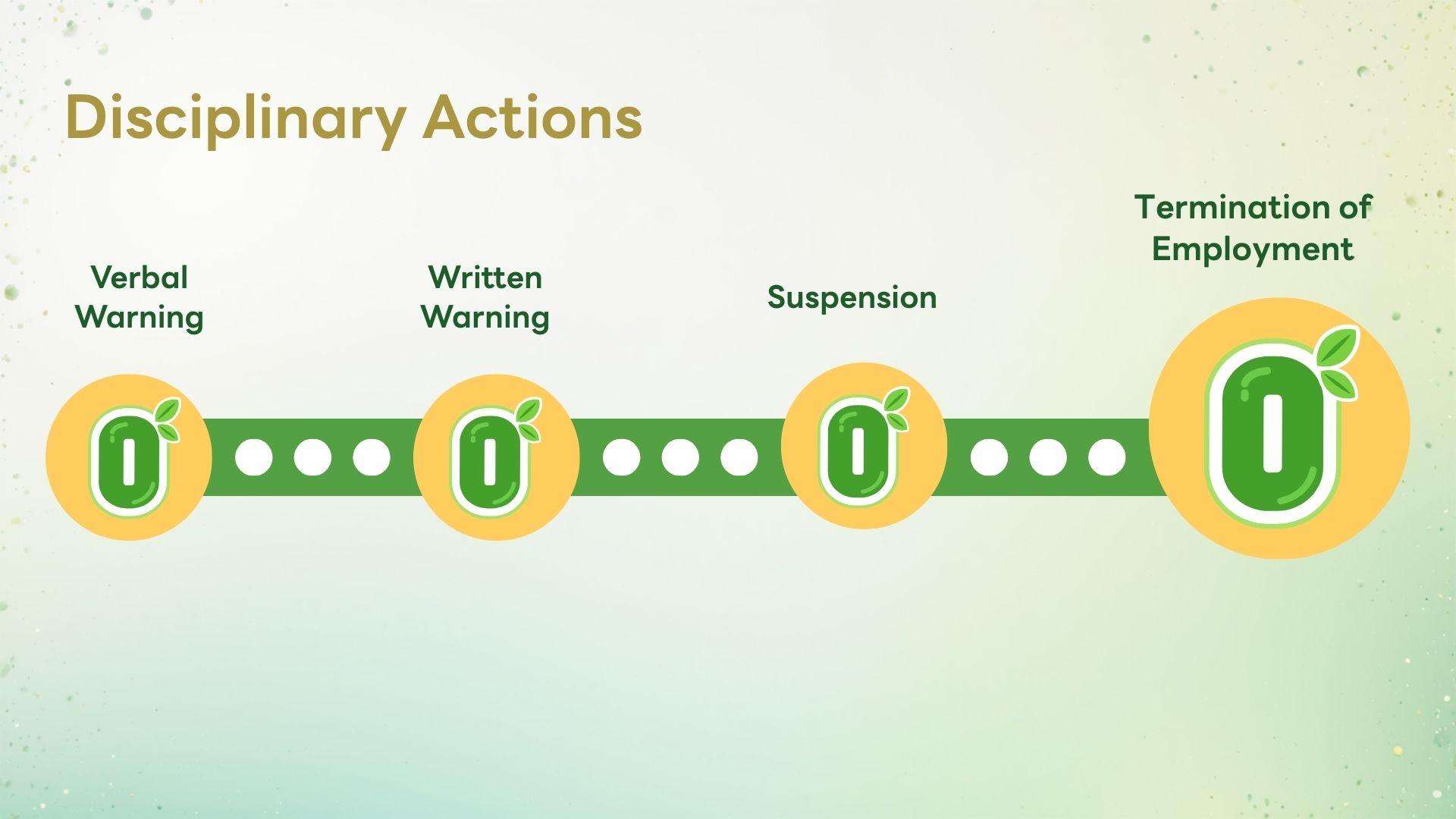 Based on the monitoring and review conducted in 2025, the Company did not identify any complaints, observations, or material policy violations that would require disciplinary consideration.
Prevention of Conflicts of Interest
Has the Company Acted to Prevent Conflicts of Interest?
Yes
Operations in the Past Year
Operations on the Prevention of the Use of Inside Information for Personal Gain During the Past Year
During the past year, the Company has continuously and systematically implemented measures to prevent the use of inside information for personal gain under the supervision of the Board of Directors. The Company recognizes that safeguarding confidential information and preventing the improper use of inside information are essential elements of good corporate governance, market transparency, and the maintenance of confidence among shareholders, investors, and all stakeholder groups.
The Company has established written policies and practices regarding the use of inside information and securities trading by directors, executives, and relevant employees. These policies have been communicated throughout the organization and disclosed on the Company’s website under the Corporate Governance section, serving as a framework for compliance and for managing related risks.
As part of its implementation, the Company requires directors and executives to acknowledge their obligations to report their securities holdings, as well as those of their spouses and minor children, and to report any changes in such holdings in accordance with applicable laws and regulations. In addition, the Company has established a blackout period for directors, executives, and persons having access to inside information, prohibiting them from trading the Company’s securities during the 30-day period prior to the disclosure of quarterly and annual financial statements, and during other periods as the Company may prescribe from time to time. Such persons may resume trading only after at least 24 hours have elapsed following the public disclosure of such information.
To ensure effective control, the Company continuously communicates relevant practices and precautions regarding the use of inside information through internal circulars, briefing sessions, and communication channels within the organization, as well as through the Company’s website. The Company also limits access to material information to authorized persons on a need-to-know basis in order to reduce the risk of access to or use of undisclosed information prior to its public release.
In addition, the Company Secretary and relevant functions are assigned to monitor compliance with such policy, including oversight of blackout periods and acknowledgment by relevant persons, and to report significant matters to the Audit Committee and the Board of Directors, as appropriate, to enable timely oversight and decision-making. These measures also form part of the Company’s corporate culture, which upholds transparency, accountability, and the prevention of the improper use of position or Company information for personal benefit.
Number of Conflict-of-Interest Cases
| Metric | Current Year | Previous Year | Two Years Ago |
|---|---|---|---|
| Total number of cases or issues related to conflicts of interest (cases) | 0 | 0 | 0 |
Prevention of the Use of Inside Information
Has the Company Acted to Prevent the Use of Inside Information?
Yes
Operations in the Past Year
Operations on the Prevention of the Use of Inside Information for Personal Gain During the Past Year
During the past year, the Company has continuously and systematically implemented measures to prevent the use of inside information for personal gain under the supervision of the Board of Directors. The Company recognizes that safeguarding confidential information and preventing the improper use of inside information are essential elements of good corporate governance, market transparency, and the maintenance of confidence among shareholders, investors, and all stakeholder groups.
The Company has established written policies and practices regarding the use of inside information and securities trading by directors, executives, and relevant employees. These policies have been communicated throughout the organization and disclosed on the Company’s website under the Corporate Governance section, serving as a framework for compliance and for managing related risks.
As part of its implementation, the Company requires directors and executives to acknowledge their obligations to report their securities holdings, as well as those of their spouses and minor children, and to report any changes in such holdings in accordance with applicable laws and regulations. In addition, the Company has established a blackout period for directors, executives, and persons having access to inside information, prohibiting them from trading the Company’s securities during the 30-day period prior to the disclosure of quarterly and annual financial statements, and during other periods as the Company may prescribe from time to time. Such persons may resume trading only after at least 24 hours have elapsed following the public disclosure of such information.
To ensure effective control, the Company continuously communicates relevant practices and precautions regarding the use of inside information through internal circulars, briefing sessions, and communication channels within the organization, as well as through the Company’s website. The Company also limits access to material information to authorized persons on a need-to-know basis in order to reduce the risk of access to or use of undisclosed information prior to its public release.
In addition, the Company Secretary and relevant functions are assigned to monitor compliance with such policy, including oversight of blackout periods and acknowledgment by relevant persons, and to report significant matters to the Audit Committee and the Board of Directors, as appropriate, to enable timely oversight and decision-making. These measures also form part of the Company’s corporate culture, which upholds transparency, accountability, and the prevention of the improper use of position or Company information for personal benefit.
Operating Results
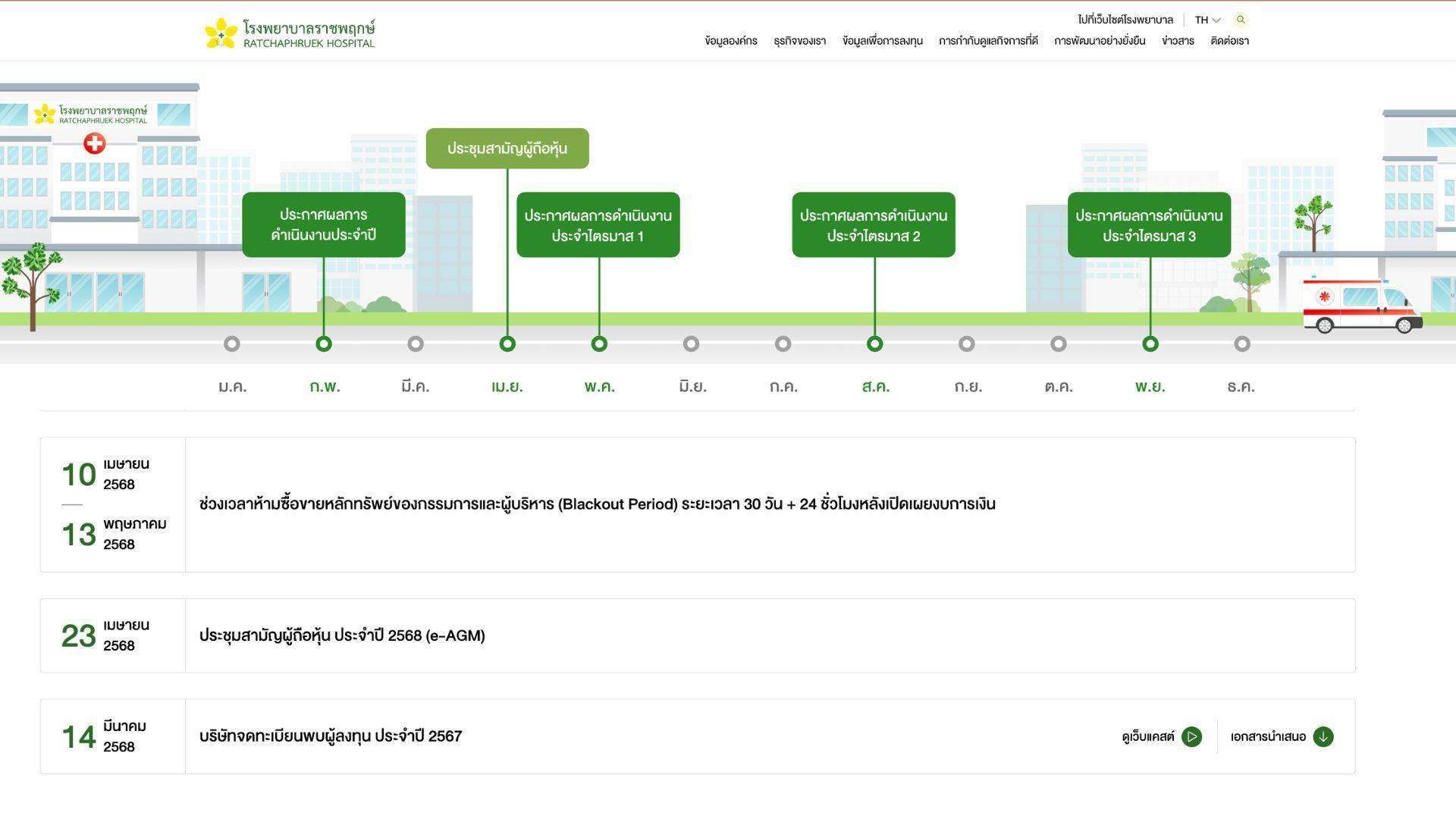
Based on the monitoring and review conducted during the past year, the Company did not identify any complaints, observations, or violations of the policy regarding the use of inside information by directors, executives, employees, or related persons, nor were there any material incidents that could adversely affect investor confidence or the Company’s reputation.
Measurement / Key Indicators
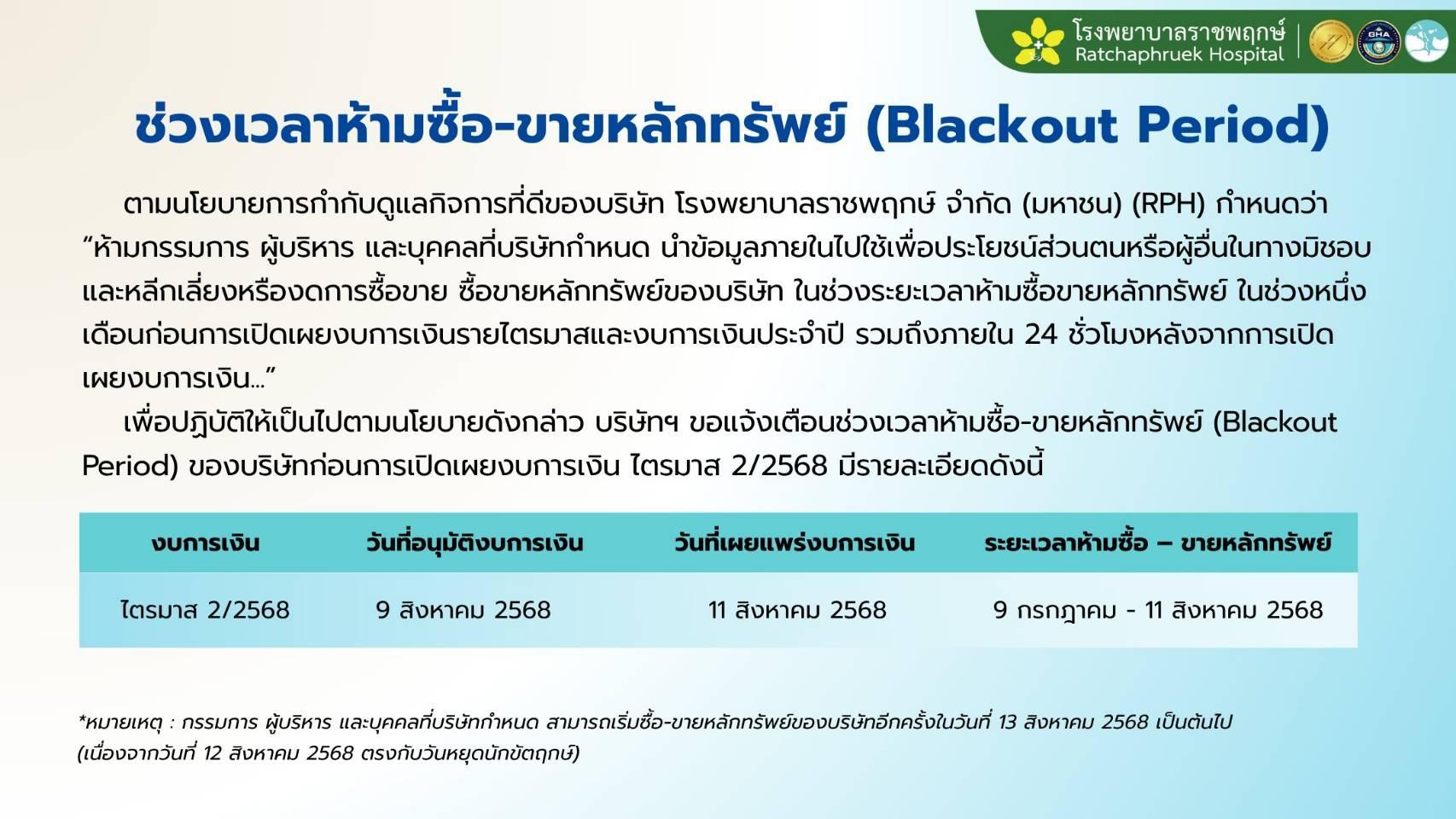
The Company applies both qualitative and quantitative monitoring to assess the effectiveness of its measures for preventing the misuse of inside information. Key indicators used in the assessment include:
review of the relevant policy and practices at least once per year;
communication and blackout period notifications to relevant persons prior to each quarterly financial announcement;
100% acknowledgment of the policy and related precautions by relevant directors and executives;
zero complaints or violations relating to the use of inside information; and
zero material incidents involving the misuse of inside information affecting the Company.
Action Plan
The Company has established an ongoing plan to further strengthen the prevention of the misuse of inside information, with emphasis on:
(1) regularly reviewing the relevant policies and practices to ensure alignment with applicable laws and regulations;
(2) communicating and notifying directors, executives, and relevant persons of blackout periods prior to each financial statement announcement;
(3) enhancing awareness regarding confidentiality obligations and restrictions on the use of inside information through continuous communication or training;
(4) reviewing access rights to material information in accordance with the need-to-know principle; and
(5) reporting monitoring results to the Audit Committee and the Board of Directors on a regular basis to ensure continued effective oversight.
Number of Inside-Information Cases
| Metric | Current Year | Previous Year | Two Years Ago |
|---|---|---|---|
| Total number of cases or issues related to the use of inside information to seek benefits (cases) | 0 | 0 | 0 |
Anti-Corruption
Has the Company Acted on Anti-Corruption?
Yes
Operations in the Past Year
Operations on Anti-Corruption During the Past Year
During the past year, the Company remained committed to conducting its business with honesty, transparency, fairness, and accountability. The Company places importance on preventing and combating corruption in all forms, whether direct or indirect, as part of good corporate governance and as a key foundation for building confidence among shareholders, investors, service recipients, business partners, and all stakeholder groups.
The Company has established a written anti-corruption policy and related practices covering key matters such as the prohibition of offering, giving, soliciting, or accepting bribes or other improper benefits; the prohibition against using one’s position for undue personal gain; controls over gifts and entertainment; charitable donations; sponsorships; and political neutrality. Such policy has been communicated continuously to directors, executives, and employees through internal circulars, briefing sessions, training programs, and disclosure on the Company’s website.
In terms of implementation, the Company has ensured that relevant functions apply such rules appropriately in their work processes, with emphasis on preventing risks at the outset. This includes establishing clear approval authority, appropriate segregation of duties, verification of supporting documents for disbursements and approvals, oversight of expenditures relating to gifts, entertainment, donations, and sponsorships in accordance with the Company’s rules, as well as monitoring transactions or behaviors that may involve ethical risks, conflicts of interest, or improper exercise of discretion.
In addition, the Company places importance on fostering a corporate culture that does not tolerate corruption by promoting awareness among personnel at all levels of their duty to perform their work with transparency and in accordance with business ethics. The Company also encourages personnel to seek advice from relevant functions whenever they encounter issues that may involve risks or may be inconsistent with the Company’s policies.
The Company has established channels for complaints or whistleblowing relating to acts that may constitute corruption or violations of the Company’s policies and ethics, together with appropriate protection measures for whistleblowers and good-faith informants. This is intended to give employees and stakeholders confidence that such reports will be handled carefully, fairly, and confidentially. Any complaints or reports received are subject to the Company’s established procedures for consideration, investigation, and follow-up.
With respect to monitoring and oversight, the Company has assigned the Audit Committee, the internal audit function, the Company Secretary, and relevant functions to jointly monitor and review the adequacy of internal control measures and assess compliance with the anti-corruption policy on a regular basis. Significant matters are reported to the Board of Directors, as appropriate, to enable timely oversight and direction. The results of such monitoring are also used as part of the review and improvement of relevant measures to further enhance their effectiveness.
To strengthen understanding and awareness, the Company continuously communicates and/or organizes knowledge-sharing activities on business ethics and anti-corruption for directors, executives, and employees. During the past year, the Company reviewed its relevant policies and practices at least once, continuously communicated or circulated such policies within the organization, conducted briefing sessions or training as appropriate, and carried out monitoring and review by relevant functions in accordance with the Company’s governance cycle.
Operating Results
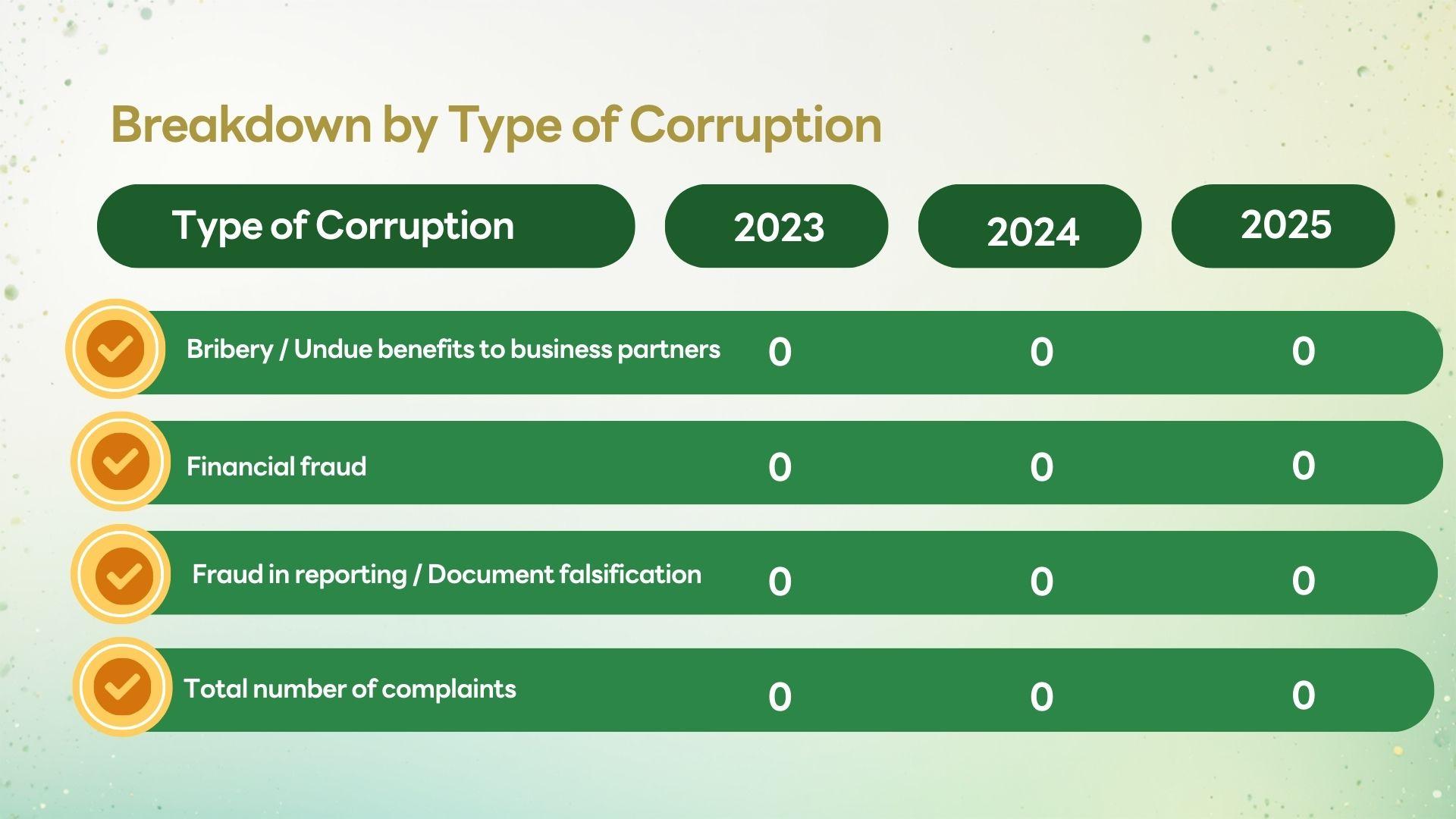 Based on the monitoring and review conducted during the past year, the Company did not find any material corruption cases or material violations of its anti-corruption policy, nor were there any incidents that materially affected the Company’s reputation, operations, or financial position. The Company will continue to review and improve relevant measures on an ongoing basis in order to further strengthen its corporate governance standards and foster a transparent, fair, and accountable corporate culture.
Measurement / Key Indicators
The Company applies both qualitative and quantitative indicators to assess the effectiveness of its anti-corruption operations. Key indicators include:
review of relevant policies and practices at least once per year;
ongoing communication and/or training for directors, executives, and relevant employees;
monitoring and review by relevant functions and reporting to the Audit Committee in accordance with the prescribed schedule;
number of material corruption complaints or cases: 0 cases; and
number of confirmed material violations of the anti-corruption policy: 0 cases.
Action Plan
The Company has established an action plan to continuously enhance the effectiveness of its anti-corruption efforts, with emphasis on:
(1) reviewing policies and practices to ensure alignment with applicable laws, regulations, and changing risk levels;
(2) regularly communicating and raising awareness among directors, executives, and employees;
(3) strengthening internal control systems in high-risk processes;
(4) promoting the use of whistleblowing channels and appropriate protection for whistleblowers; and
(5) continuously monitoring, reviewing, and reporting operating results to the Audit Committee and the Board of Directors to ensure effective oversight in line with good corporate governance principles.
Form of Anti-Corruption Operations
| Operation |
|---|
| Review of appropriateness in anti-corruption |
| Assessment and identification of corruption risk |
| Communication and training for employees on anti-corruption policy and guidelines |
| The monitoring of the evaluation of compliance with the anti- corruption policy |
Number of Corruption Cases
| Metric | Current Year | Previous Year | Two Years Ago |
|---|---|---|---|
| Total number of cases or issues related to corruption (cases) | 0 | 0 | 0 |
Whistleblowing
Has the Company Implemented Whistleblowing Procedures?
Yes
Operations in the Past Year
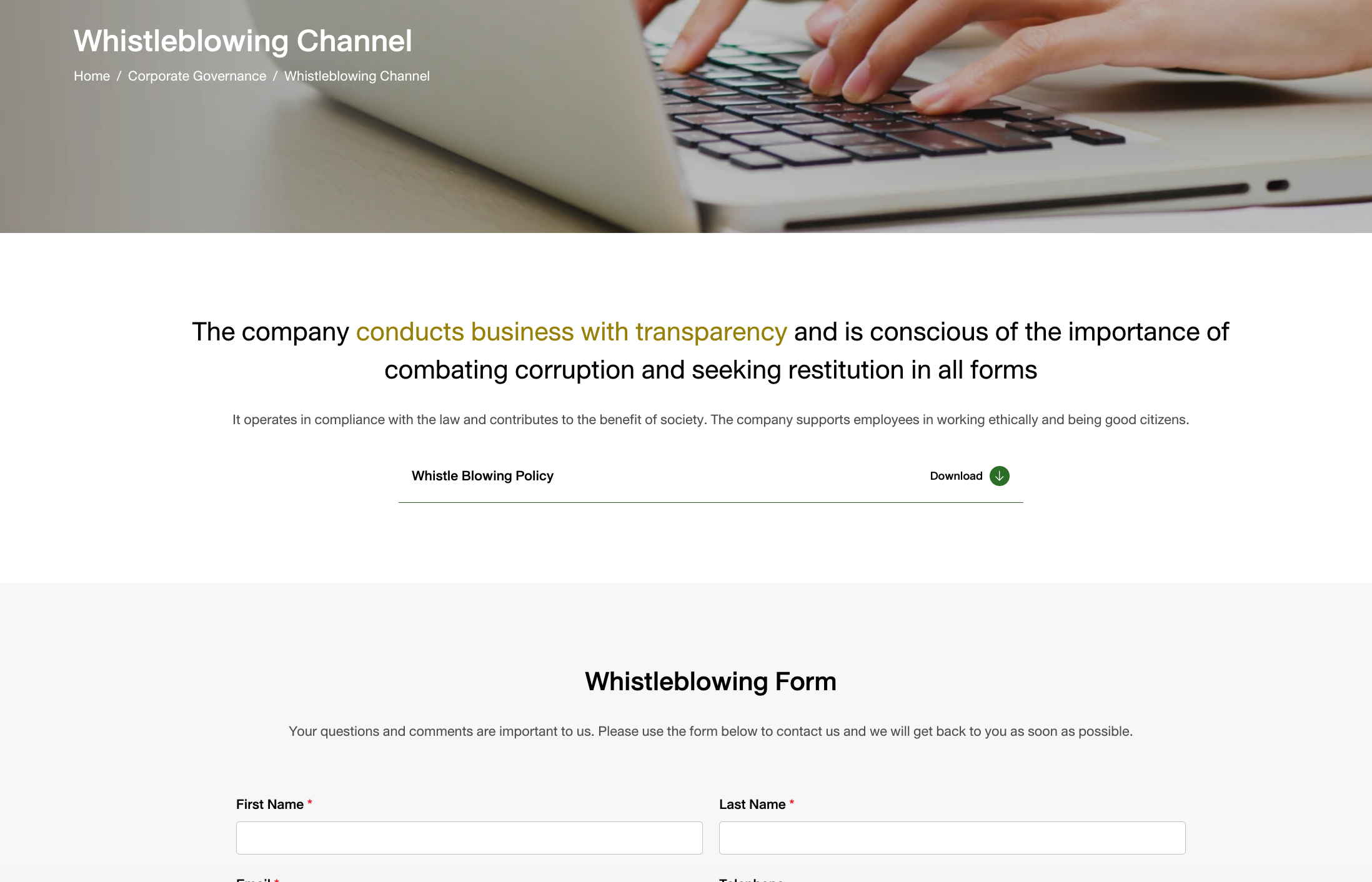 (Whistleblowing reports may be submitted via the Company’s website under the Whistleblowing Channel. https://investor.rph.co.th/en/corporate-governance/whistleblowing-channel )
The Company places importance on conducting its business with transparency, fairness, and accountability. It has therefore established a Whistleblowing Policy and clearly defined whistleblowing channels to provide directors, executives, employees, business partners, service recipients, and all groups of stakeholders with an avenue to report information, complaints, or clues regarding any acts that may violate laws, rules, regulations, business ethics, Company policies, or any acts that may constitute corruption, conflicts of interest, or other inappropriate conduct, in a convenient and secure manner.
The Company has established appropriate and accessible whistleblowing channels through which whistleblowers may submit information via the channels prescribed by the Company, such as email, the Company’s website, or other complaint channels of the Company. In this regard, the Company seeks to ensure that such channels are clear, easily accessible, and supportive of comprehensive reporting by stakeholders.
To build confidence among whistleblowers, the Company has established a Whistleblower Protection Policy for whistleblowers and good-faith informants. The Company protects the personal data, identity, and details of whistleblowers as confidential information, limits access strictly to those with a need to know, and has put in place measures to prevent whistleblowers from suffering hardship, unfair treatment, harassment, discrimination, or retaliation, whether directly or indirectly, as a result of making a report in good faith.
Upon receiving a complaint or whistleblowing report, the Company will conduct a preliminary review of the facts. If the matter appears to have grounds, the Company will carry out an investigation or examination in accordance with established procedures in an appropriate, transparent, and fair manner. Depending on the nature of the matter, the Company may assign relevant functions, such as Internal Audit, Legal, Human Resources, the Company Secretary, or the Audit Committee, to conduct the review and report the results through the appropriate channels.
The Company requires follow-up on the handling of complaints or whistleblowing reports and mandates that significant matters be reported to the Audit Committee and/or the Board of Directors, as appropriate, in order to enable timely oversight, direction, and corrective action. Information obtained from complaints and whistleblowing reports is also used as part of the Company’s ongoing efforts to improve its internal control system, work processes, and governance measures.
Operating Results on Whistleblower Protection
During the past year, the Company has continuously implemented its whistleblowing and whistleblower protection policies by clearly establishing reporting channels and protection measures for whistleblowers and good-faith informants, such as maintaining confidentiality of information, restricting access only to relevant persons, and prohibiting retaliation or harassment against whistleblowers. The Company has also continuously communicated such policies to personnel and stakeholders. During the past year, the Company did not identify any material complaints or whistleblowing reports relating to wrongdoing or violations of the Company’s policies.
Action Plan
The Company has an ongoing plan to further enhance its whistleblowing system and whistleblower protection measures, with emphasis on:
(1) reviewing the whistleblowing policy and channels to ensure greater appropriateness and accessibility;
(2) communicating and raising awareness among directors, executives, employees, and stakeholders regarding their right to report concerns in good faith;
(3) strengthening confidence in whistleblower protection measures and the confidentiality of information; and
(4) following up on reported matters and using the information received to continuously improve the Company’s internal control system and corporate governance.
Number of Whistleblowing Cases
| Metric | Current Year | Previous Year | Two Years Ago |
|---|---|---|---|
| Total number of cases or issues received through whistleblowing channels (cases) | 0 | 0 | 0 |
Selection of Directors & Chief Executives
Directors & Chief Executives — Introduction
The Company requires that the nomination and selection of the Chief Executive Officer be conducted with due care, transparency, and in accordance with the principles of good corporate governance. The Board of Directors has the authority and duty to consider the suitability of any person to be appointed as the Chief Executive Officer, in order to ensure that the Company appoints an individual who possesses the qualifications, knowledge, capabilities, and experience appropriate for managing the Company’s business.
In considering the nomination and selection of the Chief Executive Officer, the Board of Directors takes into account various qualifications, including knowledge, capability, experience, leadership, vision, and a sufficient understanding of the Company’s business, as well as the ability to manage the organization in a manner that achieves the objectives set out in the policies, business plans, and strategic direction approved by the Board of Directors. In particular, the candidate must have an appropriate understanding of the hospital business environment, which involves quality of medical treatment, patient safety, professional standards, and compliance with applicable regulatory requirements.
In addition, any person being considered for appointment as the Chief Executive Officer must possess integrity, ethics, honesty, and a transparent work record, and must not have any prohibited characteristics under applicable laws, regulatory requirements, the Company’s Articles of Association, or relevant internal policies.
The nomination and selection process is undertaken in alignment with the Company’s business plans, organizational structure, management plan, and operational needs in each period, in order to ensure that the appointment of the Chief Executive Officer is appropriate to the business circumstances and capable of effectively responding to changes.
In this regard, the Board of Directors will consider the suitability of the nominated candidate in all relevant aspects before submitting the matter to the Board of Directors’ meeting for approval of the appointment in accordance with the Company’s governance process.
The Company intends for the nomination and appointment of the Chief Executive Officer to serve as an important mechanism in supporting the Company’s operations to be carried out efficiently, transparently, and accountably, while maintaining an appropriate balance among operational performance, good corporate governance, risk management, and long-term sustainable growth.
Are Directors Selected Through the Nomination Committee?
No
Are Chief Executives Selected Through the Nomination Committee?
No
Number of Directors from Major Shareholders
1
Rights of Minority Shareholders on Director Appointment
Rights of Minority Shareholders in the Appointment of Directors
• Proposing Director Nominations
The Company provides minority shareholders with the opportunity to propose qualified individuals for consideration as candidates for election as directors in advance of the Annual General Meeting of Shareholders, in accordance with the criteria established by the Company. Shareholders are informed of this opportunity through the disclosure system of the Stock Exchange of Thailand and on the Company’s website. Further details are available on the Company’s website under the “Investor Relations” section.
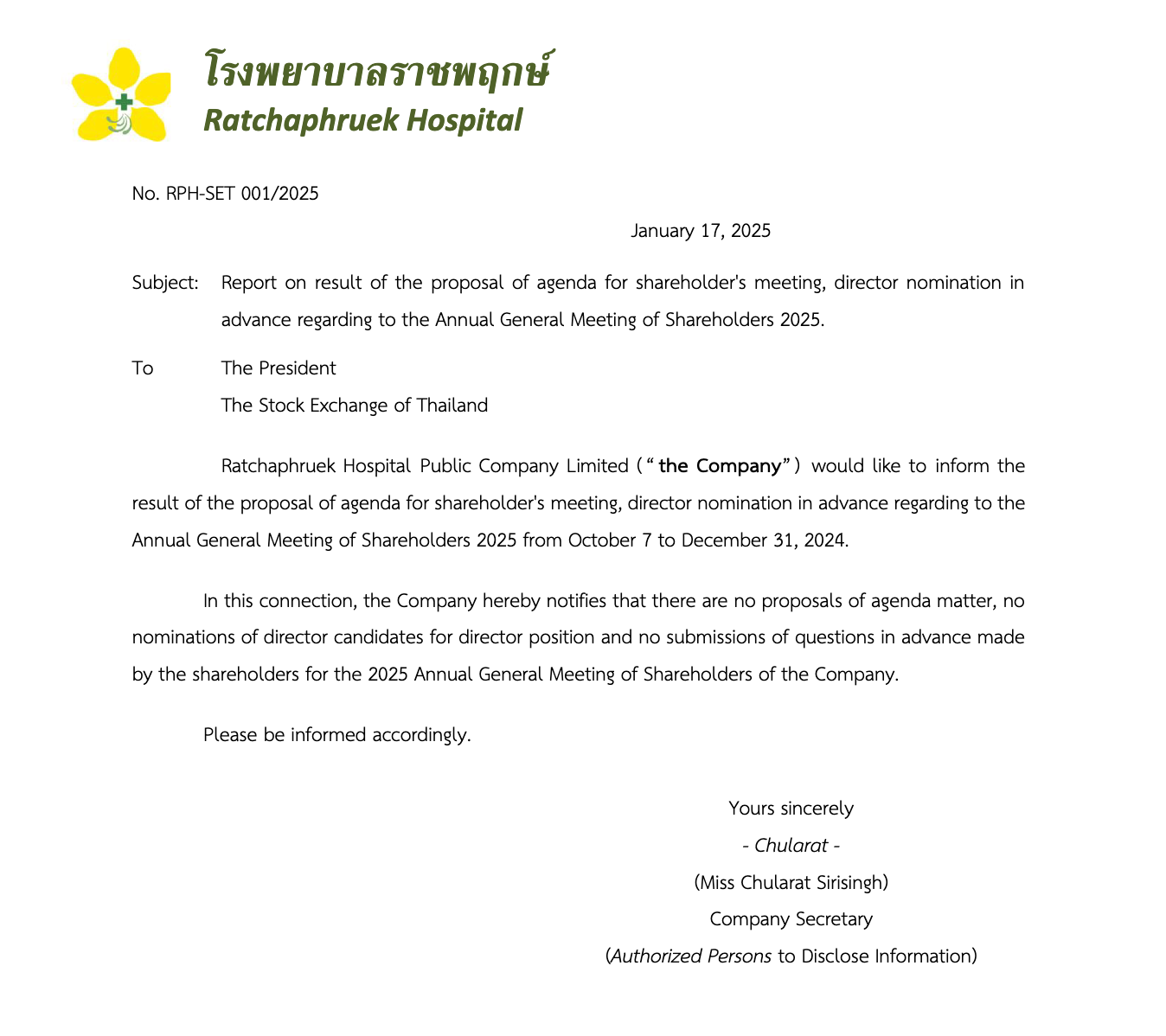
In 2025, the Company allowed minority shareholders to propose candidates for consideration as directors to replace those retiring by rotation during the period from October 1 to December 31, 2024. However, no shareholder submitted any nomination for consideration as a director of the Company.
Method of Director Appointment
| Method |
|---|
| Method whereby each director requires approval votes more than half of the votes of attending shareholders with voting rights |
Selection of Independent Directors
Introduction
Recruitment of Independent Directors
According to the Company's regulations, individuals appointed to the positions of directors and executives must meet the qualifications required by Section 58 of the Public Limited Companies Act B.E. 2535 and the Securities and Exchange Act B.E. 2535. They must also not have any disqualifications as stipulated by law. The recruitment and appointment of directors are outlined in the following details.
To align with the Company’s corporate governance policy and comply with the regulations of the Stock Exchange of Thailand, the Company has defined an independent director as someone who is free from any influence or interest in the Company’s operations, both directly and indirectly.
Qualifications of Independent Directors
The Board of Directors has approved the definition of "Independent Director" in accordance with the announcement of the Securities and Exchange Commission.
1) Must hold no more than 1% of the total shares with voting rights of the Company, including the parent Company, subsidiaries, affiliates, major shareholders, or controlling persons of the applicant. This also includes shares held by related persons of the independent director.
2) Must not be, or have ever been, a director involved in management, an employee, a salaried consultant, or a controlling person of the Company, parent Company, subsidiaries, affiliated companies, major shareholders, or controlling persons of the Company, unless the individual has ceased from such roles for at least two years before submitting the application to the office. This restriction does not apply to cases where the independent director has previously been a civil servant or a consultant for a government agency that is a major shareholder or controlling person of the Company.
3) Must not have a familial relationship or legal registration as a father, mother, spouse, sibling, or child, including the spouse of a child, of any other director, executive, major shareholder, controlling person, or any individual proposed to be a director, executive, or controlling person of the Company.
4) Must not have, or have ever had, any business relationship with the Company, its subsidiaries, affiliates, major shareholders, or controlling persons in a way that could impede the independent exercise of judgment, nor must the individual have been a shareholder with significant influence or a controlling person of any party with a business relationship with the Company, subsidiaries, affiliates, major shareholders, or controlling persons of the Company. This restriction applies unless the individual has ceased from such relationships for at least two years prior to submitting the application to the office.
The business relationships referred to in the previous paragraph include regular business transactions, such as leasing or renting property, asset or service transactions, or financial assistance through lending, guaranteeing, or using assets as collateral. This includes any other similar transactions that result in liabilities requiring repayment by either party, provided that the liability amounts to at least 3% of the net tangible assets of the Company, or at least 20 million baht, whichever is lower.
The calculation of such liabilities must follow the methods for calculating the value of related party transactions as prescribed by the Securities and Exchange Commission, with similar conditions. When considering such liabilities, any debts arising within one year before establishing a business relationship with the same individual should also be included.
5) Must not be, or have ever been, the auditor of the Company, parent Company, subsidiaries, affiliates, major shareholders, or controlling persons of the Company, and must not be a shareholder with significant influence, controlling person, or partner of an auditing firm where the auditor of the Company, parent Company, subsidiaries, affiliates, major shareholders, or controlling persons of the Company is affiliated. This restriction applies unless the individual has ceased from such relationships for at least two years before submitting the application to the office.
6) Must not be, or have ever been, a provider of any professional services, including legal or financial advisory services, and must not have received more than two million baht annually in fees from the Company, parent Company, subsidiaries, affiliates, major shareholders, or controlling persons of the Company. Additionally, must not be a shareholder with significant influence, controlling person, or partner of such professional service provider. This restriction applies unless the individual has ceased from such relationships for at least two years before submitting the application to the office.
7) Must not be a director appointed to represent the directors of the Company, major shareholders, or shareholders related to major shareholders. 8) Must not be engaged in a business that is of the same nature and significantly competitive with the business of the Company or its subsidiaries. Additionally, must not be a partner with significant influence in a partnership or a director involved in managing, employed as an employee, or receiving a salary, or holding more than 1% of the total shares with voting rights of another Company that operates a business that is of the same nature and significantly competitive with the Company or its subsidiaries.
9) Must not have any other characteristics that would impair their ability to provide an independent opinion on the Company’s operations. If the Securities and Exchange Commission announces changes to the qualifications of independent directors, the Company’s independent directors must meet the new requirements in full. After being appointed as an independent director in accordance with items 1 to 9 above, independent directors may be assigned by the board to make decisions in the operations of the applicant Company, parent Company, subsidiaries, affiliates, major shareholders, or controlling persons of the applicant. Such decisions can be made in a collective decision-making manner.
In the past fiscal period, the independent directors of the Company had no business relationships or professional service relationships, nor did any individuals appointed as independent directors have, or have ever had, business relationships or professional service relationships exceeding the criteria set by the Securities and Exchange Commission regarding the approval and offering of newly issued shares.
All independent directors of the Company maintain their independence from the management and major shareholders of the Company.
In the past year 2024, the five independent directors did not have any business relationships or provide professional services in excess of the specified criteria. The five independent directors met the specified criteria, which did not affect their duties and independent opinions.
Criteria for Selecting Independent Directors
Criteria and Process for the Nomination of Directors
As the Company has not yet established a Nomination and Remuneration Committee, the Board of Directors is responsible for considering, selecting, and screening qualified individuals in accordance with the Company’s Articles of Association and applicable laws, with the objective of appointing directors who possess professional qualifications, relevant expertise, and appropriate diversity in line with the Board structure and the Company’s business direction. The Board of Directors will then submit its views to the Board for approval before proposing the nominated candidates to the shareholders’ meeting for election in accordance with the relevant rules and procedures.
In this regard, the Company also provides shareholders with the opportunity to propose suitably qualified persons for consideration as directors of the Company.
Criteria for the Selection of Independent Directors
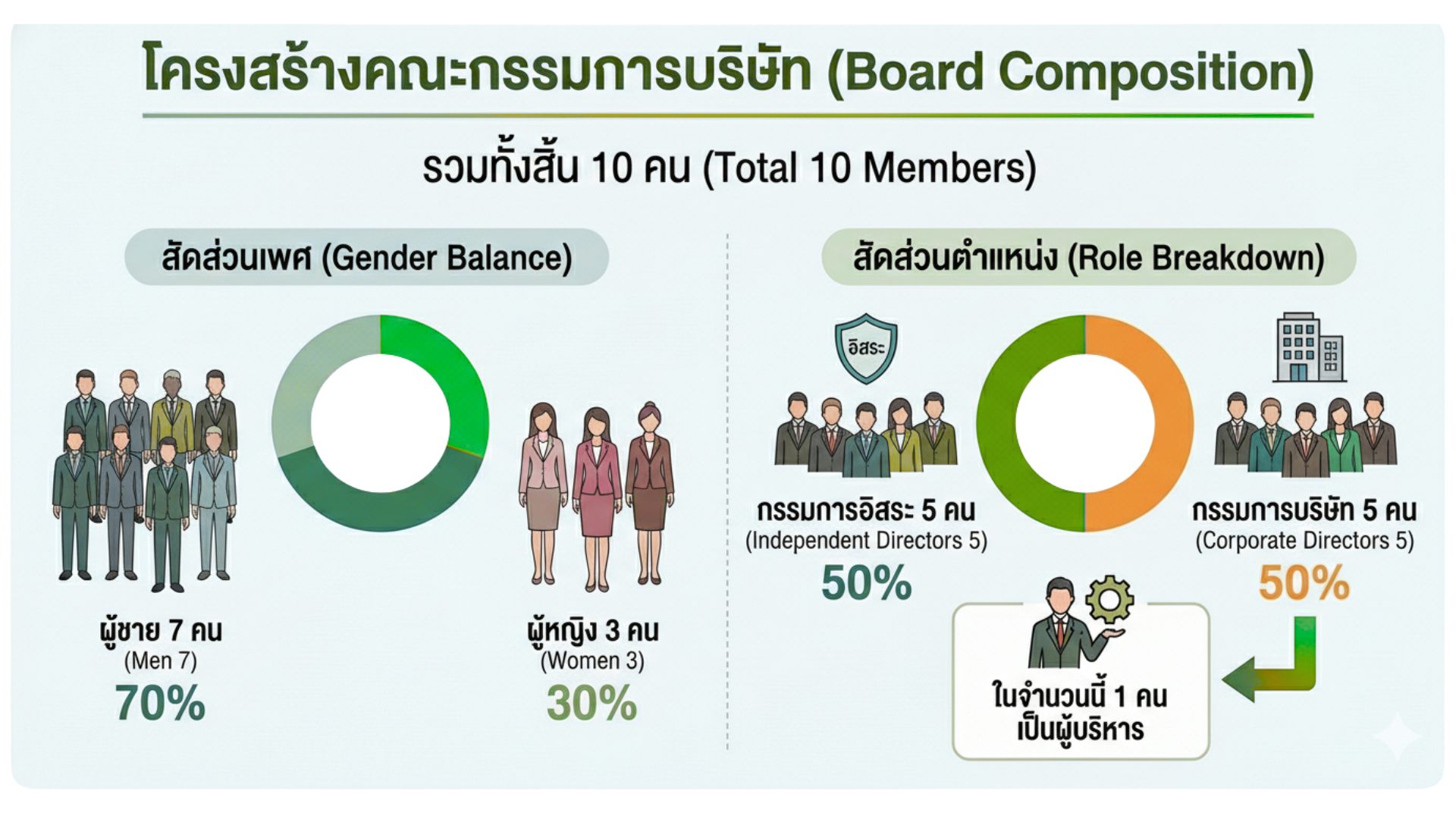
As of December 31, 2025, the Company had 5 independent directors out of a total of 10 directors. These independent directors are persons who are independent from management and major shareholders. The number of independent directors is in compliance with the criteria of the Securities and Exchange Commission, which require listed companies to have at least one-third of the total number of directors, and not fewer than three persons, serving as independent directors.
In the nomination and appointment of independent directors, the Board of Directors considers the qualifications of suitable candidates by taking into account their knowledge, capabilities, experience, independence, and other qualifications required by law and relevant regulations. The Board also considers nominations from both major and minority shareholders, as well as director databases from reputable organizations, such as the Director Pool maintained by relevant professional institutions.
The Company has defined the qualifications of independent directors in accordance with the notification of the Capital Market Supervisory Board.
1) Criteria and Process for the Nomination and Appointment of New Directors
In the event of a vacancy on the Board of Directors, or where the Company wishes to increase the number of directors, the Board of Directors will nominate qualified persons through a transparent and fair process. Consideration will be given to qualifications in various aspects, including knowledge, capabilities, work experience, skills, and expertise that are necessary for the Company’s business, as well as leadership, vision, independence, and the ability to devote sufficient time to the Company’s affairs.
In this process, the Board of Directors uses the Board Skill Matrix as a supporting tool to assess which knowledge, expertise, or experience may still be needed on the Board in light of the Company’s business operations, strategies, and objectives, and to determine the qualifications of directors to be nominated accordingly.
In addition, the Company takes into account its Board Diversity Policy, without limiting candidates on the basis of gender, age, race, or nationality, and encourages the nomination of candidates with diverse gender, age range, and experience. This is intended to ensure that the Board composition is appropriate, balanced, and capable of bringing a variety of perspectives that are beneficial to corporate governance and strategic decision-making.
In 2025, the Board of Directors considered the nomination of a qualified person whose background would be consistent with the Company’s needs in the areas of audit, finance, banking, and investment, and proposed such nomination to the shareholders’ meeting for approval in order to increase the number of directors to an appropriate level for corporate governance purposes. The shareholders’ meeting subsequently approved the appointment of Ms. Thina Singsajja as an independent director.
2) Sources of Nomination
The Board of Directors nominates suitably qualified persons to serve as directors of the Company from various reliable sources, including:
Recommendations or referrals from members of the Board of Directors
Nominations from shareholders
External consultants, where appropriate
Director databases (Director Pool) maintained by relevant professional organizations
For the nomination and appointment of new directors in 2025, the Board of Directors used sources including recommendations from members of the Board of Directors and the Director Pool of the Thai Institute of Directors Associatio
3) Re-election of Directors Retiring by Rotation
As the Company has not established a Nomination Committee, the Board of Directors is responsible for considering qualified persons in accordance with the relevant criteria, including the re-election of directors who retire by rotation.
In considering whether to re-elect a director who retires by rotation for another term, the Board of Directors, excluding directors with a conflict of interest, will consider the performance of each director during the past term. Such consideration is based on the annual performance evaluation, meeting attendance, level of participation and contribution of opinions and recommendations to the Company and Board meetings, participation in the Company’s activities, and the ability to perform duties independently and appropriately.
After such consideration, the Board of Directors will summarize its views and submit them to the Board for approval before proposing the names of such directors to the shareholders’ meeting for consideration and approval of their re-election.
In 2025, the Board of Directors proposed to the Annual General Meeting of Shareholders the re-election of directors retiring by rotation for another term as directors of the Company.
Did Any Independent Director Have a Business or Professional Relationship?
No
Director Development
Development of Directors in the Past Year
Director Development, Training/Seminars/Participation in Company
Activities Director and Executive Development
The Board of Directors and executives are aware of their roles, duties, and responsibilities towards the Company. The Company places great importance on the development of human resources throughout the organization to align with the leadership and vision of the directors and executives. This development is aimed at enhancing their knowledge, skills, and potential by supporting participation in seminars and training programs that are beneficial to their duties, both internally and externally. It also includes opportunities for directors and executives to meet and exchange views with those from other organizations to bring back knowledge and experience. To further develop the Company, the following initiatives have been implemented.
1) The Board of Directors promotes and facilitates training and education for those involved in the Company's corporate governance system, such as directors, audit committee members, executives, and the Company Secretary, to continuously improve performance. Training and education can be conducted internally within the Company or by using services from external institutes.
2) The Board requires orientation for all new directors to ensure they understand the business and various operations of the Company. This prepares them to carry out their duties effectively, with the Company Secretary coordinating aspects such as business structure, board structure, scope of duties, essential laws, general business knowledge, and operational guidelines.
3) The Board has established a policy for the development of directors and executives and discloses this policy in the 2025 Annual Information Filing (Form 56-1 One Report) of the Company.
Evaluation of Board & Subcommittee Performance
Evaluation — Introduction
The Company places importance on the performance evaluation of the Board of Directors as an important mechanism for enhancing the effectiveness of corporate governance and improving the performance of directors in an appropriate, transparent, and good-governance manner.
The Company requires that the performance of the Board of Directors be evaluated at least once a year. The evaluation covers both the performance of the Board as a whole and the self-assessment of individual directors. This serves as a tool for reviewing roles, duties, responsibilities, meeting effectiveness, participation in discussions, and areas requiring further improvement.
In this regard, the Chairman of the Board oversees the evaluation process to ensure that it is conducted appropriately and effectively, and has assigned the Company Secretary to be responsible for preparing and distributing the evaluation forms, collecting and processing the information, summarizing the evaluation results, and reporting the results to the Board of Directors for consideration.
All directors complete the evaluation independently and may freely provide comments or suggestions for improvement. The evaluation results are used to support the review of Board effectiveness, the appropriateness of Board composition, areas in which additional knowledge development may be required, and guidelines for improving the Board’s performance in the following year.
These practices reflect the Company’s commitment to ensuring that the Board of Directors performs its duties with responsibility, prudence, and effectiveness, which are key foundations of good corporate governance and of building confidence among shareholders and all stakeholders.
Performance Evaluation of the Board of Directors, Sub-Committees, and the Chief Executive Officer
The Company places importance on the performance evaluation of the Board of Directors, sub-committees, and the Chief Executive Officer as an important mechanism for enhancing the effectiveness of corporate governance and continuously improving the management of the organization in line with the principles of good corporate governance.
1) Performance Evaluation of the Board of Directors
The Board of Directors requires that the performance of the Board be evaluated at least once a year. The evaluation is divided into three parts:
Evaluation of the Board as a whole (As a Whole)
Individual director self-assessment (Self-Assessment)
Evaluation of the Chief Executive Officer (Chief Executive Officer Evaluation)
In this regard, the Chairman of the Board oversees the evaluation process to ensure that it is conducted appropriately, transparently, and effectively, and has assigned the Company Secretary to be responsible for the evaluation process, including preparing and distributing the evaluation forms, following up and collecting responses from directors, processing the scores, summarizing the evaluation results, and reporting the results to the Board of Directors for acknowledgement and consideration.
The Company Secretary distributes the evaluation forms to all directors so that they may evaluate the performance of the Board of Directors and any sub-committees on which they serve. All directors are able to complete the evaluation independently and may provide comments or suggestions for improvement freely.
After all evaluation forms have been returned, the Company Secretary will collect, process, and summarize the results and present them to the Chairman of the Board and the Board of Directors. The Board will then consider the evaluation results, analyze areas for improvement, and determine measures or guidelines to further enhance the effectiveness of the Board’s performance.
The Company requires that evaluation results be presented as a percentage of the full score for each item, in order to ensure that the results are clear, systematic, and comparable across evaluation periods.
2) Performance Evaluation of the Sub-Committees
The Company requires that the performance of each sub-committee be evaluated at least once a year as a tool to review the effectiveness of each sub-committee and to support the overall development of the Company’s corporate governance practices.
The evaluation of each sub-committee covers three key areas:
Structure and qualifications of sub-committee members
Roles, duties, and responsibilities of the sub-committee
Meetings and operational effectiveness of the sub-committee
Criteria for Evaluating Board Performance
Evaluation Process
The performance evaluation process requires that each sub-committee be evaluated as a whole at least once a year. The Chairman of the Board assigns the Company Secretary to be responsible for conducting the evaluation, collecting and processing the information, and summarizing the evaluation results of each sub-committee. The Company Secretary then presents the evaluation results to the Board of Directors for consideration, acknowledgement, and determination of guidelines to improve the effectiveness of each sub-committee in the following year.
Where there are recommendations or areas requiring improvement, the Company Secretary will compile the key points and communicate the evaluation results to the relevant committees for use in their continuous improvement.
Evaluation Criteria
The Company has established the following evaluation score ranges:
90% and above: Excellent
70% and above but below 90%: Very Good
50% and above but below 70%: Satisfactory
Below 50%: Needs Improvement
Use of Evaluation Results
The Company places importance on using the evaluation results to improve the performance of the Board of Directors, sub-committees, and the Chief Executive Officer in a concrete manner. The results are used to support the review of Board composition, the appropriateness of roles and responsibilities, meeting effectiveness, areas in which additional knowledge development may be needed, and ways to further strengthen the Company’s corporate governance practices.
This process reflects the Company’s commitment to good corporate governance by emphasizing systematic evaluation, transparency, accountability, and continuous improvement, in order to strengthen the effectiveness of the Board and build confidence among shareholders and all stakeholders.
Evaluation of Board Performance in the Past Year
The results of the self-assessment of the Board of Directors for the year 2025 are as follows:
1) Board of Directors Evaluation Criteria
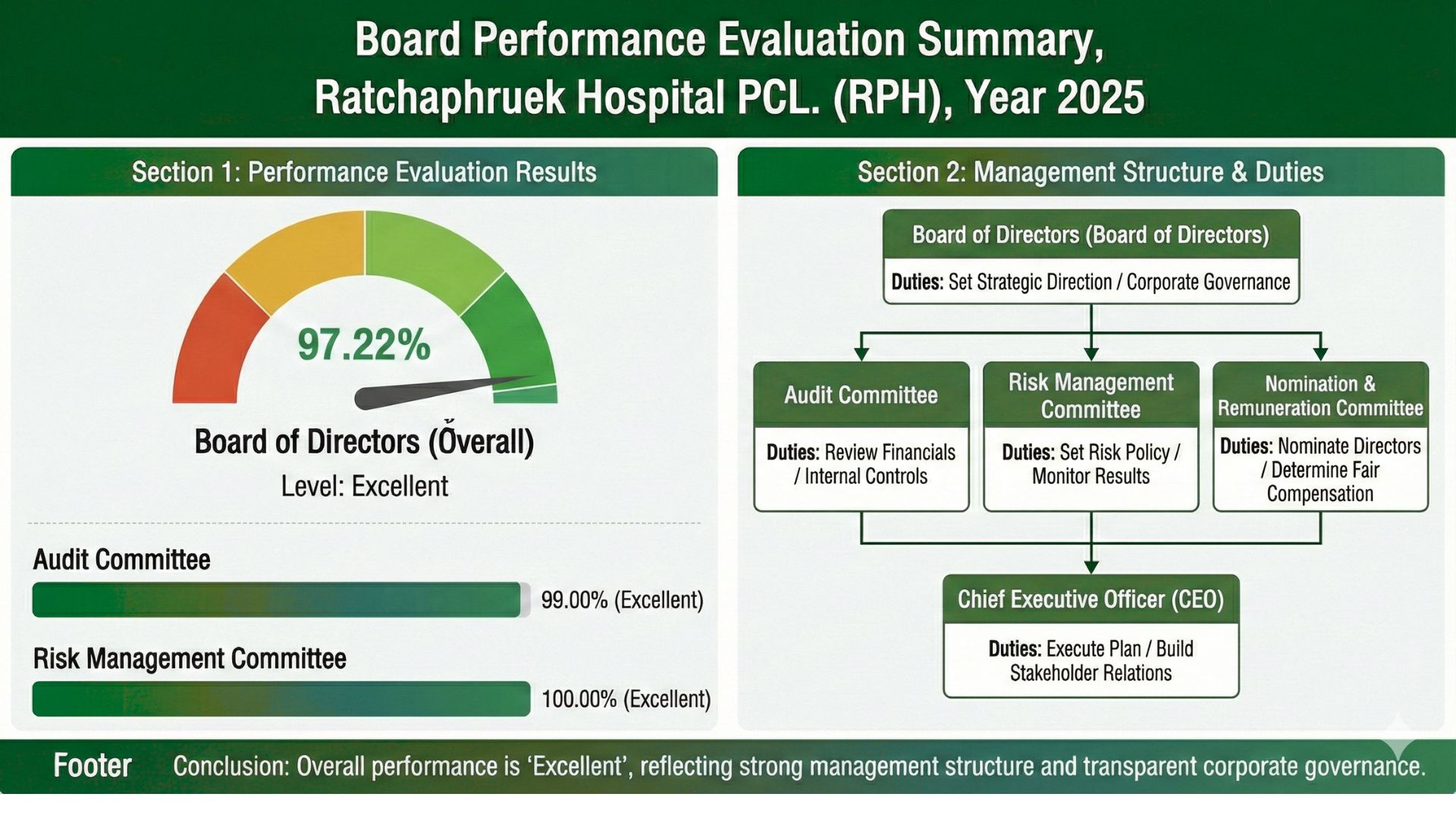
• Board Evaluation (As a Whole) score 97.22% Excellent Range
• Individual Director Evaluation score 93.88% Excellent Range
In summary, the overall results of the Board of Directors' performance evaluation for the year 2025 were rated "Excellent" in both formats including the evaluation of the entire Board and the self-assessment (directors evaluating themselves).
The Board considers these evaluation results to be beneficial for improving the efficiency of the Board's performance in the future.
2) Subcommittee Evaluation
(1) Audit Committee
• Audit Committee Evaluation (As a Whole) score 99% Excellent Range
• Audit Committee Individual Director Evaluation score 98.70% Excellent Range
The annual performance evaluation of the subcommittees involves evaluating three areas including the structure and qualifications of the committee members, the roles, duties, and responsibilities of the committee, and the committee meetings.
(2) Risk Management Committee
• Risk Management Committee Evaluation (As a Whole) score 100% Excellent Range
• Risk Management Committee Individual Director Evaluation score 93.88% Excellent Range
The annual performance evaluation of the subcommittees involves evaluating three areas including the structure and qualifications of the committee members, the roles, duties, and responsibilities of the committee, and the committee meetings.
3) Summary of the Chief Executive Officer’s Performance Evaluation
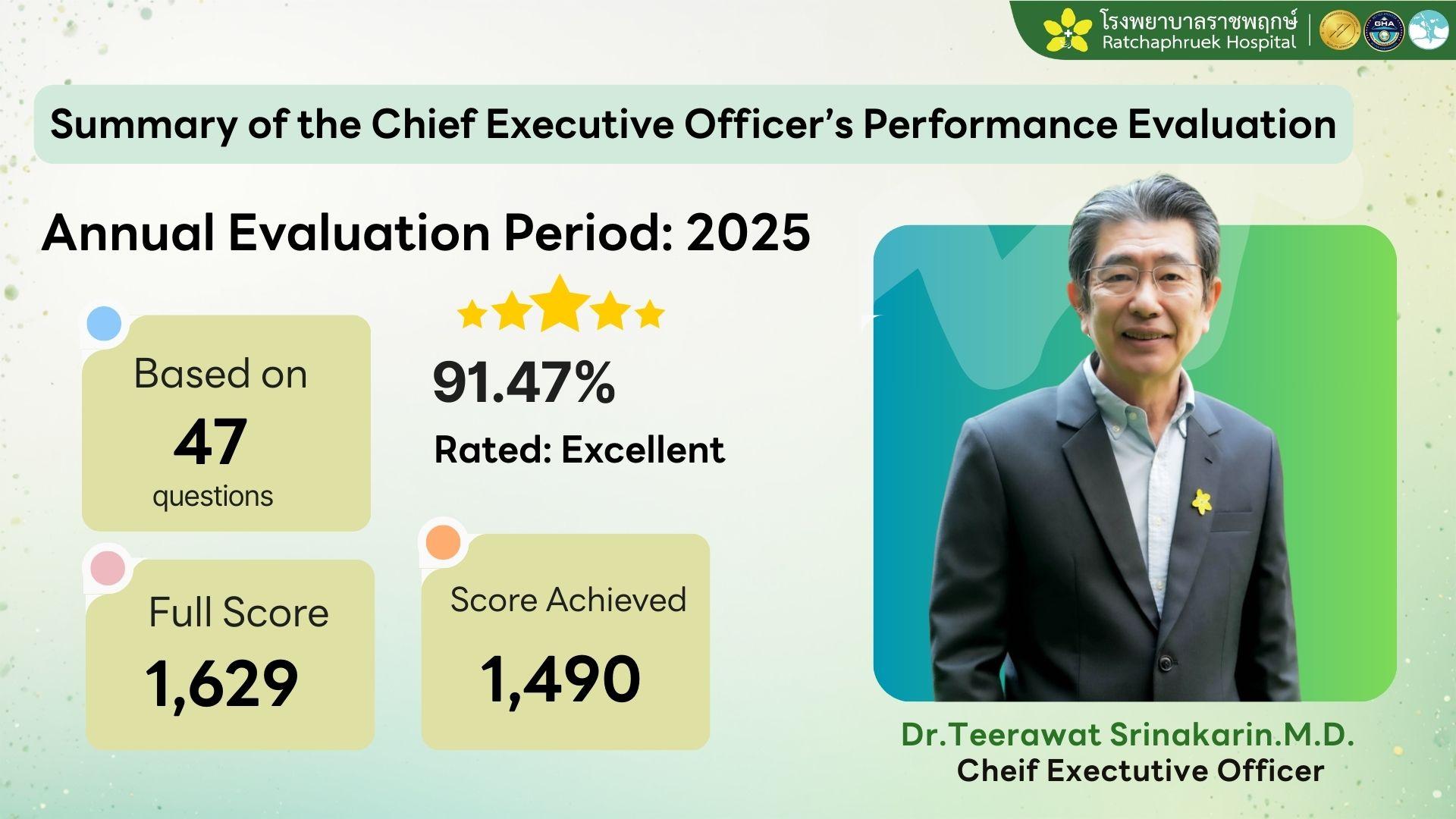
The Board of Directors conducts the Chief Executive Officer’s performance evaluation on an annual basis, based on key performance indicators aligned with the Company’s strategy, business objectives, operating results, management capability, leadership, and good corporate governance. The evaluation results are used as supporting information for consideration of remuneration, capability development, and the setting of performance targets for the following year.
In 2025, the Board of Directors completed the performance evaluation of the Chief Executive Officer in accordance with the established criteria. The evaluation result was rated at the Excellent level, with an average score of 91.47 points.
Evaluation Results
| Evaluated Body | Group — Carried Out? | Group — Grade / Average Score | Group — Grade / Full Score | Individual (Self-Assessment) — Carried Out? | Individual (Self-Assessment) — Grade / Average Score | Individual (Self-Assessment) — Grade / Full Score | Cross (Assessing Other Directors) — Carried Out? |
|---|---|---|---|---|---|---|---|
| Board Of Director | Y | 97.22% | 100% | Y | 93.88% | 100% | N |
| Audit Committee | Y | 99% | 100% | Y | 98.70% | 100% | N |
| Other Subcommittee | Y | 100% | 100% | Y | 93.88 | 100% | N |
Subcommittees
Subcommittees
| Results of the Subcommittee's Duty Performance |
|---|
The Risk Management Committee of Ratchapruek Hospital Public Company Limited has been appointed by the Board of Directors, consisting of 3 members, consisting of 2 independent directors and 1 non-executive director. During 2025, there were 2 Risk Management Committee meetings in total to support the management to operate with maximum efficiency through the Risk Management Committee meetings in total of 2 meetings to consider and screen issues that may have significant impacts in all dimensions. The names of the Risk Management Committee members are as follows: 1. Mr. Suphan Srithamma, Chairman of the Risk Management Committee 2. Mr. Vairoj Jindamaneepitak, Member of Risk Management Committee 3. Mrs. Tina Singhsacha, Member of Risk Management Committee
1. Review of Risk Management Policy and Framework The Risk Management Committee reviewed the Company’s risk management policy, enterprise risk management framework, and risk governance guidelines to ensure alignment with the Company’s strategic plan, business objectives, and the changing business environment, both at the enterprise and operational levels. This was to ensure that the Company’s risk management remained systematic, appropriate, and consistent with the acceptable level of risk. 2. Identification and Assessment of Key Risks The Risk Management Committee oversaw the identification, analysis, and assessment of the Company’s key risks in a comprehensive manner, particularly risks relevant to the hospital and healthcare services business, such as patient quality and safety risks, medical and healthcare personnel risks, compliance risks relating to laws and standards applicable to healthcare facilities, information technology and health data risks, reputational risks, as well as risks arising from economic factors, industry competition, and changes in government regulations. 3. Monitoring of Risk Management Plans The Risk Management Committee continuously monitored the progress of control measures and risk management plans implemented by various functions and provided recommendations to management to further enhance the effectiveness of risk management. Emphasis was placed on requiring each function to clearly assign responsible persons, establish key indicators, and develop risk mitigation plans so that progress could be monitored in a concrete manner. 4. Monitoring of Emerging Risks and Risks Arising from Change The Risk Management Committee closely monitored emerging risks and environmental factors that could affect the Company’s business operations, such as changes in laws and regulations applicable to the healthcare business, competition in the hospital industry, developments in medical technology, cybersecurity, protection of personal data and health information, as well as risks arising from emergencies or situations that could affect business continuity. This was to ensure that the Company would be prepared and able to respond in an appropriate and timely manner. 5. Coordination with the Audit Committee, Internal Audit, and Management The Risk Management Committee appropriately coordinated with the Audit Committee, the internal audit function, and management to ensure that risk oversight, internal control, and follow-up on key issues were carried out in an integrated and effective manner. This supports the alignment of the Company’s risk management system with its internal control system and the principles of good corporate governance. 6. Promotion of a Risk Management Culture Throughout the Organization The Risk Management Committee supported the development of a risk management culture throughout the organization by encouraging executives and employees at all levels to recognize their roles and responsibilities in identifying, reporting, and managing risks. It also promoted the integration of risk management into the Company’s planning, decision-making, and day-to-day operations so that risk management would not be viewed as the responsibility of only one function, but rather as a shared responsibility across the entire organization. Overall Opinion of the Risk Management Committee Based on the performance of its duties throughout 2025, the Risk Management Committee is of the opinion that Ratchaphruek Hospital Public Company Limited has an appropriate and adequate risk management system that is consistent with the nature, size, and complexity of its hospital and healthcare services business, and that the Company is reasonably able to respond to changes in internal and external factors that may affect its operations. The Risk Management Committee is also of the opinion that management has continuously attached importance to risk management, has identified and monitored the Company’s key risks, has implemented appropriate control measures and risk management plans for significant issues, and has regularly reported progress to the Risk Management Committee. The Risk Management Committee will continue to monitor and enhance the Company’s risk management process in order to support stable and sustainable growth in line with the principles of good corporate governance. |
Meeting Attendance & Remuneration
Meeting Attendance — Introduction
Attendance at Meetings and Individual Directors’ Remuneration
The Board of Directors requires that meetings be held at least four times per year. Meeting dates are scheduled in advance for the entire year, and the Company Secretary is assigned to distribute the meeting schedule and agenda to the Board in advance so that directors can appropriately plan their time and attend the meetings. However, meeting dates may be adjusted as appropriate depending on the necessity and significance of the matters to be submitted for consideration.
In 2025, the Company held meetings of the Board of Directors and sub-committees as follows:
Board of Directors
A total of 4 meetings were held, with directors’ attendance ratio at 4/4 meetings. In addition, there was 1 meeting of the Board of Directors held without executive directors present, bringing the total to 5 meetings.Audit Committee
A total of 4 meetings were held, with Audit Committee members’ attendance ratio at 4/4 meetings. In addition, there was 1 meeting of the Audit Committee held without management present, bringing the total to 5 meetings.Risk Management Committee
A total of 2 meetings were held, with attendance ratio at 2/2 meetings.
In addition, the Chairman of the Board, the Chief Executive Officer, and the Independent Lead Director jointly consider and determine matters to be included on the meeting agenda. Where significant agenda items are involved, relevant executives or responsible persons may be invited to attend the meeting in order to provide additional necessary information to the Board.
The Company Secretary is responsible for delivering the notice of meeting together with supporting documents to directors at least 7 days in advance of the meeting date, so that directors have sufficient time to review the information and consider the matters carefully, except in urgent circumstances.
Supporting Corporate Governance Through Diverse Meeting Formats

The Company supports board meetings in a variety of formats to enhance directors’ accessibility and convenience in attending meetings, including on-site, online, and hybrid formats. This helps improve efficiency in the performance of duties, increase flexibility in meetings, and support the continuity and effectiveness of the Board’s oversight.
Justification for Directors' Non-Attendance
Overseas leave
Remuneration — Introduction
Directors’ and Executives’ Remuneration Policy
The Company has established a remuneration policy for directors and executives that is aligned with the Company’s strategy, long-term objectives, and operating performance. In determining remuneration, the Company takes into account the appropriateness of each position with respect to experience, duties, scope of role, responsibilities, and time commitment, while ensuring that the remuneration remains competitive and comparable with that of companies in the same industry. This is to support the attraction and retention of qualified personnel with the appropriate knowledge, capabilities, and experience.
The Company requires that directors’ remuneration be transparent, appropriate, and verifiable, and classifies such remuneration into two categories:
Monetary remuneration
Non-monetary remuneration or benefits
Types of Remuneration of the Board of Directors
Monetary Remuneration
The monetary remuneration of directors is provided in the following forms:
Monthly remuneration
Meeting allowances
Directors’ gratuity
Annual bonus
Non-Monetary Remuneration or Benefits
The non-monetary remuneration or benefits provided to directors consist of:
Medical welfare benefits
Annual health check-ups for directors and their families
with a limit of not exceeding Baht 300,000 per person per year.
In this regard, both monetary and non-monetary remuneration for directors must be considered and approved by the shareholders’ meeting, and their appropriateness is reviewed annually to ensure alignment with business conditions, operating performance, and the principles of good corporate governance.
Remuneration of the Board — Introduction
Directors’ Remuneration Approved for 2025
In 2025, the Annual General Meeting of Shareholders approved the directors’ remuneration as follows:
1) Monthly remuneration for directors
The Chairman of the Board and all directors receive monthly remuneration at the rate of Baht 15,000 per person per month, with the same rate applicable to all directors.
2) Meeting allowances
Meeting allowances are paid only to directors who attend the meetings, with details as follows:
The Chairman of the Board receives a meeting allowance of Baht 18,000 per meeting.
Directors receive a meeting allowance of Baht 15,000 per meeting.
The chairman of each sub-committee receives a meeting allowance of Baht 18,000 per person per meeting.
Members of each sub-committee receive a meeting allowance of Baht 15,000 per person per meeting.
3) Annual bonus
The annual bonus is set at 2% of the dividend paid, but the total amount must not exceed Baht 1,800,000. The Board of Directors is responsible for allocating such amount among themselves within the limit approved by the shareholders’ meeting. In this regard, the annual bonus is approved separately from the monthly remuneration and meeting allowances.
4) Other remuneration
None
The Company considers that such remuneration policy and structure are appropriate and consistent with the roles and responsibilities of the directors, support the effective performance of their duties, and are in line with the principles of good corporate governance for listed companies.
Remuneration Payable — Introduction
In 2025, the Company had no outstanding remuneration or benefits payable, as all such payments had been fully made within the year.
Remuneration or Benefits Payable to the Board
| Metric | Amount (Baht) | Remark |
|---|---|---|
| Remunerations or benefits pending payment to the board of directors over the past year (baht) | 0 | The Board of Directors has considered allocating directors’ remuneration in the amount of Baht 1,800,000 for the directors, to be equally distributed among each director at Baht 180,000 per person. Such amount has already been included in the table of directors’ remuneration under “Other Remuneration.” |
Supervision of Subsidiaries & Associated Companies
Does the Company Have Subsidiaries or Associated Companies?
Yes
Is There a Mechanism for Overseeing Subsidiaries and Associated Companies?
Yes
Mechanism for Overseeing Management of Subsidiaries
Governance of Subsidiaries and Affiliates

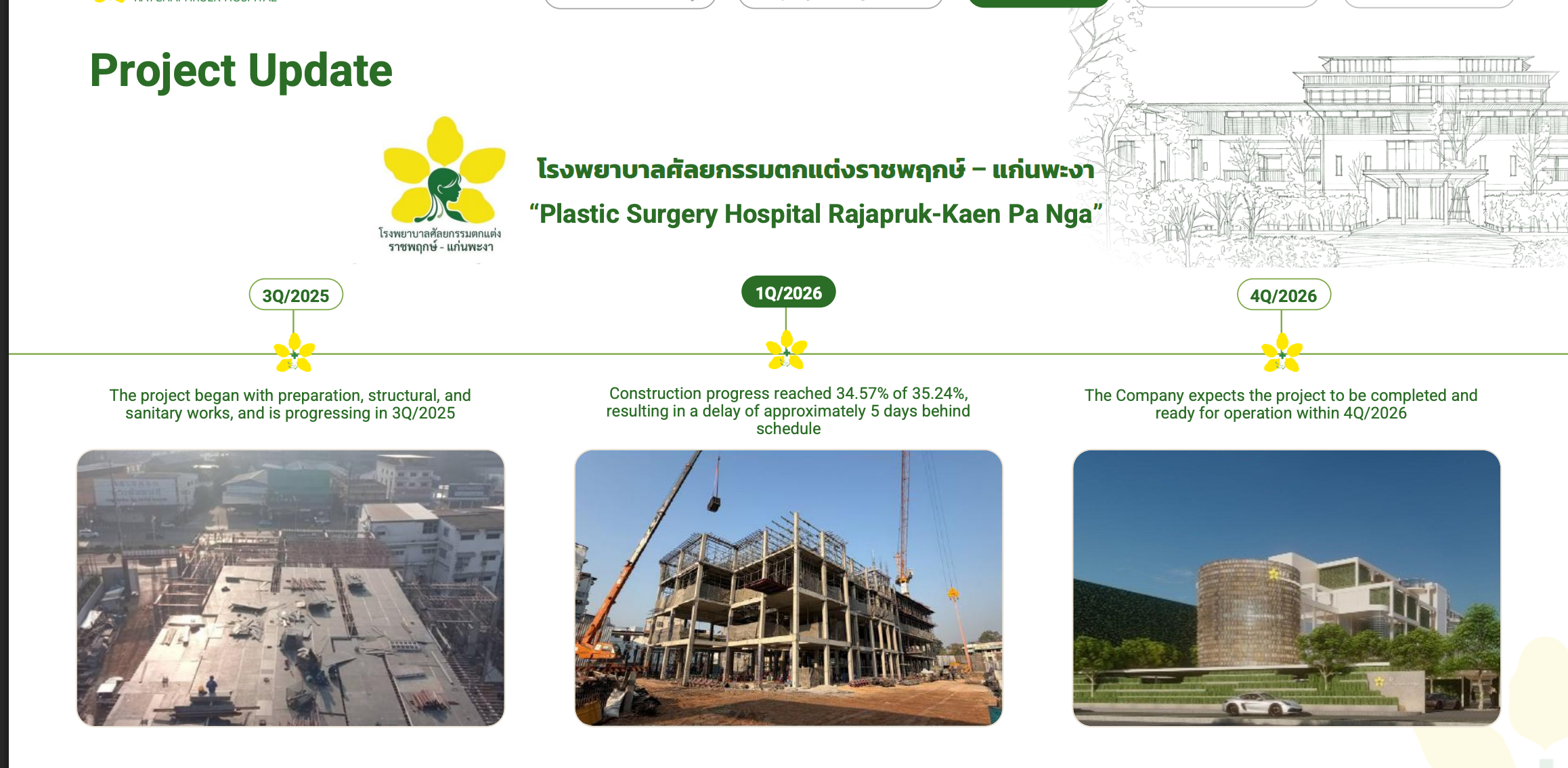 The Company has one subsidiary, Kaen Pa Nga Co., Ltd. (Kaen Pa Nga). To protect the investment interests and ensure that the subsidiary operates in compliance with relevant laws, regulations, and criteria, and to manage the operations in alignment with the Company's policies effectively and efficiently, the Company has established a governance policy for the operations of its subsidiaries and affiliates.
1. The Company send its representatives to serve as directors in each subsidiary and/or affiliate in proportion to its shareholding. The representatives who serve as directors must be considered and approved by the Board of Directors, taking into account the appropriateness for each Company. T
2. The directors of the subsidiary and/or affiliate appointed by the Company are responsible for overseeing these matters.
o Overseeing the subsidiary's and/or affiliate's business operations to ensure they align with the approved business policies, goals, strategies, and plans.
o Attending meetings and casting votes at the board meetings of the subsidiary and/or affiliate on important matters related to the business operations of the subsidiary and/or affiliate.
o Ensuring that the subsidiary and/or affiliate has an effective internal control system and risk management system that is adequate and robust. o Ensuring that the subsidiary and/or affiliate complies with announcements and guidelines regarding transactions or operations that fall under asset acquisitions or disposals and related-party transactions, as per the criteria of the Stock Exchange of Thailand and the Securities and Exchange Commission. Additionally, ensuring the subsidiary and/or affiliate discloses financial status, operating performance, related-party transactions, asset acquisitions or disposals, and other significant transactions, such as capital increases, capital reductions, or Company dissolution
3. If a subsidiary and/or affiliate is involved in any transactions that require the Company to disclose information to the Stock Exchange of Thailand as per the prescribed criteria, the subsidiary and/or affiliate must immediately notify the Company's management as soon as they are aware that such a transaction or event will occur.
Oversight Mechanisms
| Mechanism |
|---|
| Defining the scope of powers, duties and responsibilities of directors and executives who represent the company in setting important policies |
| Internal control system of the subsidiary operating the core business is appropriate and sufficient in the subsidiary operating the core business |
| Acquisition or disposal of assets |
| Other important transactions |
| Transactions between the Company and related persons |
| Disclosure of financial information and operating results |
Agreements Between the Company and Shareholders in Managing Subsidiaries
As of December 31, 2028, the Company has no shareholders’ agreement regarding the management of subsidiaries and associates.
Audit Committee Duty Performance
Results of the Audit Committee's Duty Performance in the Past Year
Report on the Audit Committee’s Performance of Duties During the Past Year
The Audit Committee has performed its duties within the scope, duties, and responsibilities set out in the charter approved by the Board of Directors, which is in line with the requirements of the Stock Exchange of Thailand.
For the 2025 financial year, the Audit Committee consisted of three independent directors as follows:
Mr. Vairoj Jindamaneepitak – Chairman of the Audit Committee
Mr. Vorathep Rangchaikul – Audit Committee Member
Ms. Orawan Sirirattanawong – Audit Committee Member
Ms. Chularat Sirisingh served as Secretary to the Audit Committee.
During the year, the Audit Committee held a total of four meetings, with all members attending each meeting, thereby constituting a quorum on every occasion. In addition, the Audit Committee held one meeting with the external auditor without the presence of management.
Key Duties Performed in 2025
1. Review of Financial Statements and Disclosure
The Audit Committee reviewed the quarterly financial statements and the annual financial statements for 2025, which had been reviewed and audited by the external auditor. In doing so, it considered significant matters such as accounting estimates, the appropriateness of accounting policies, adjustments to significant items, audit scope, and the independence of the external auditor, as well as the completeness and adequacy of disclosures, in order to ensure that the financial statements were prepared in accordance with applicable laws and financial reporting standards, and were accurate, reliable, and timely.
2. Review of Internal Audit and Internal Control Systems
The Audit Committee reviewed the independence, scope of work, and audit results of the internal audit function, followed up on corrective actions taken in response to recommendations, and assessed the adequacy of the internal control system in accordance with the COSO framework using the SEC’s assessment form. The assessment results indicated that the Company’s internal control system was adequate and appropriate, and that no material weaknesses were identified.
3. Good Corporate Governance
The Audit Committee promoted and oversaw the Company’s operations in accordance with the principles of good corporate governance, based on transparency, accountability, fairness, and due consideration of all stakeholder groups. It also reviewed whether significant information was disclosed adequately, accurately, and in a timely manner in accordance with regulatory requirements and best practices for listed companies.
In 2025, the Audit Committee reviewed the Company’s policies and practices relating to business ethics, whistleblowing and whistleblower protection, as well as the Company’s anti-corruption policies and measures, to ensure that the Company had an appropriate governance framework covering the prevention of fraud risk, bribery, improper use of position for personal benefit, and behavior that may be contrary to the Company’s governance principles.
The Audit Committee also monitored whether the Company had clear, convenient, and appropriate complaint-handling and whistleblowing channels, together with fair procedures for the consideration and follow-up of complaints, as well as protection measures for whistleblowers and good-faith informants, in order to encourage personnel and stakeholders to confidently report information or concerns regarding potentially inappropriate conduct.
In addition, the Audit Committee reviewed the adequacy of the internal control system and processes relating to anti-corruption measures, and monitored the performance of relevant functions to ensure that the Company had appropriate systems for prevention, investigation, and reporting of significant matters, as part of the Company’s continued enhancement of good corporate governance standards.
4. Compliance with Laws and Relevant Requirements
The Audit Committee reviewed the Company’s compliance with securities and exchange laws, regulatory requirements, and obligations to third parties, and found no material non-compliance with laws or relevant requirements.
5. Connected Transactions and Conflicts of Interest
The Audit Committee reviewed connected transactions and transactions that may involve conflicts of interest, and expressed the opinion that such transactions were conducted under normal commercial terms, were reasonable, fair, and in the best interests of the Company, with proper and complete disclosure in accordance with the prescribed rules.
6. Proposal for the Appointment of the External Auditor for 2025
The Audit Committee assessed the independence, competence, and performance of the external auditor for 2025 and resolved to propose to the Board of Directors for further submission to the shareholders’ meeting the appointment of PV Audit Co., Ltd. as the Company’s external auditor for the year 2025, together with the consideration of the audit fee.
7. Maintaining the Quality of the Audit Committee
The Audit Committee performed its duties in accordance with its charter and in line with the principles of good corporate governance. It also conducted an annual self-assessment of its performance, the results of which reflected that the Audit Committee had fully and effectively discharged its duties under the charter with independence.
From the performance of its duties throughout 2025, the Audit Committee is of the opinion that the Company has accurate and reliable accounting and financial reporting systems, and adequate and appropriate internal control systems. The Company also maintains good corporate governance, as well as appropriate anti-corruption measures, complaint-handling procedures, and whistleblower protection measures that are aligned with the nature of the Company’s business operations. In addition, the Company has complied fully with applicable laws and relevant regulations. In this regard, the Audit Committee did not identify any material issues relating to violations of the anti-corruption policy or deficiencies in the complaint-handling and whistleblower protection processes that could have a significant impact on the Company.